What Actually Happens When an AC Fails Here
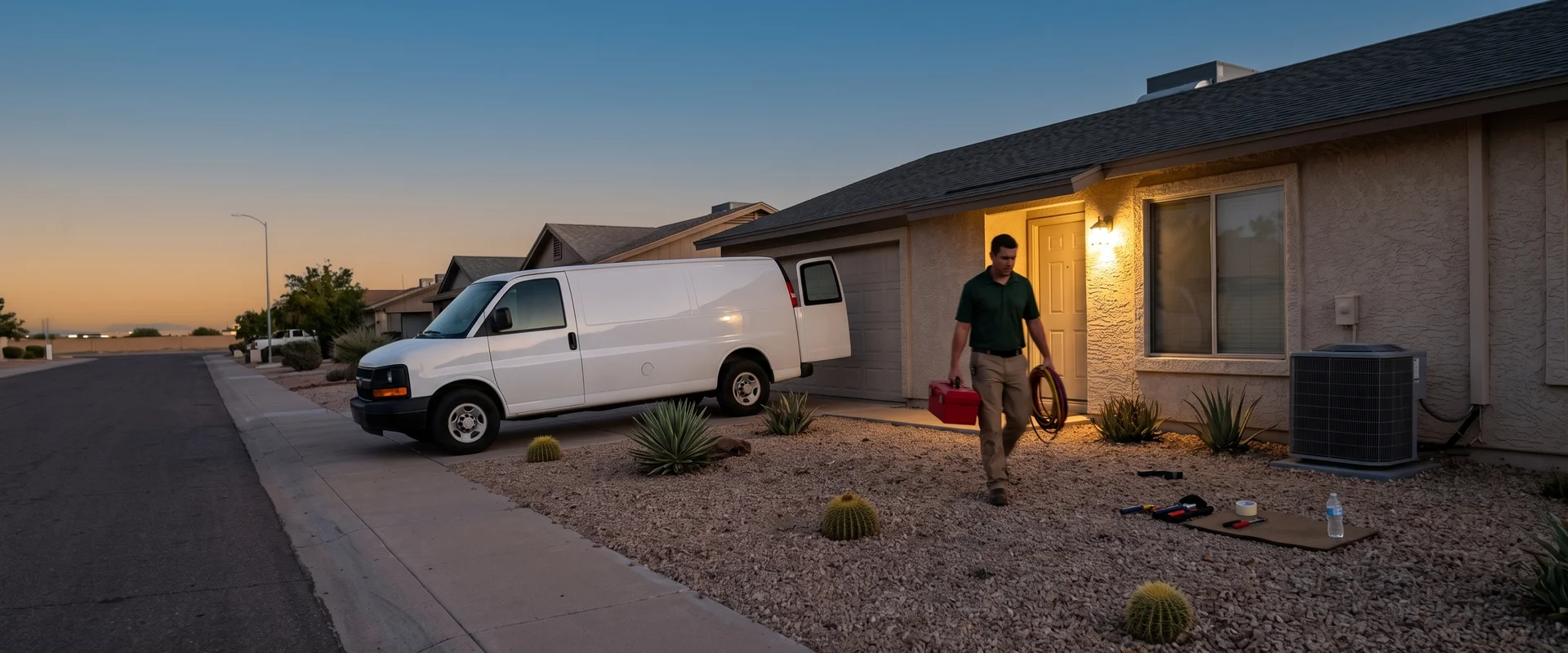
When an air conditioner quits in a Southwest summer, the house heats up faster than most homeowners expect. A typical insulated home gains five to ten degrees an hour through a mid-summer afternoon, so a failure at noon is an unlivable house by dinner. That is the reason we dispatch same-day across Maricopa County and Los Angeles County and carry the common failure parts on every truck rather than ordering them.
Most failures trace back to a short list of components. Dual run capacitors cooked by ambient temperatures past 110. Pitted contactors that no longer reliably pull in the compressor. A failing TXV starving the evaporator coil. A frozen coil caused by a filter nobody has changed since spring. An ECM blower motor that has run eight months a year for a decade. None of these are exotic, and all of them are diagnosable in under an hour with the right instruments.
What is different about this market is the duty cycle. An eight-month cooling season puts more runtime on a Sonoran Desert system in two years than a northern system accumulates in five, and the Sonoran Desert design temperature that equipment should be sized against is meaningfully higher than the national rating assumes. Components fail earlier here, and the failures cluster in the exact weeks when every technician in the valley is already booked.
What a Real Diagnostic Includes
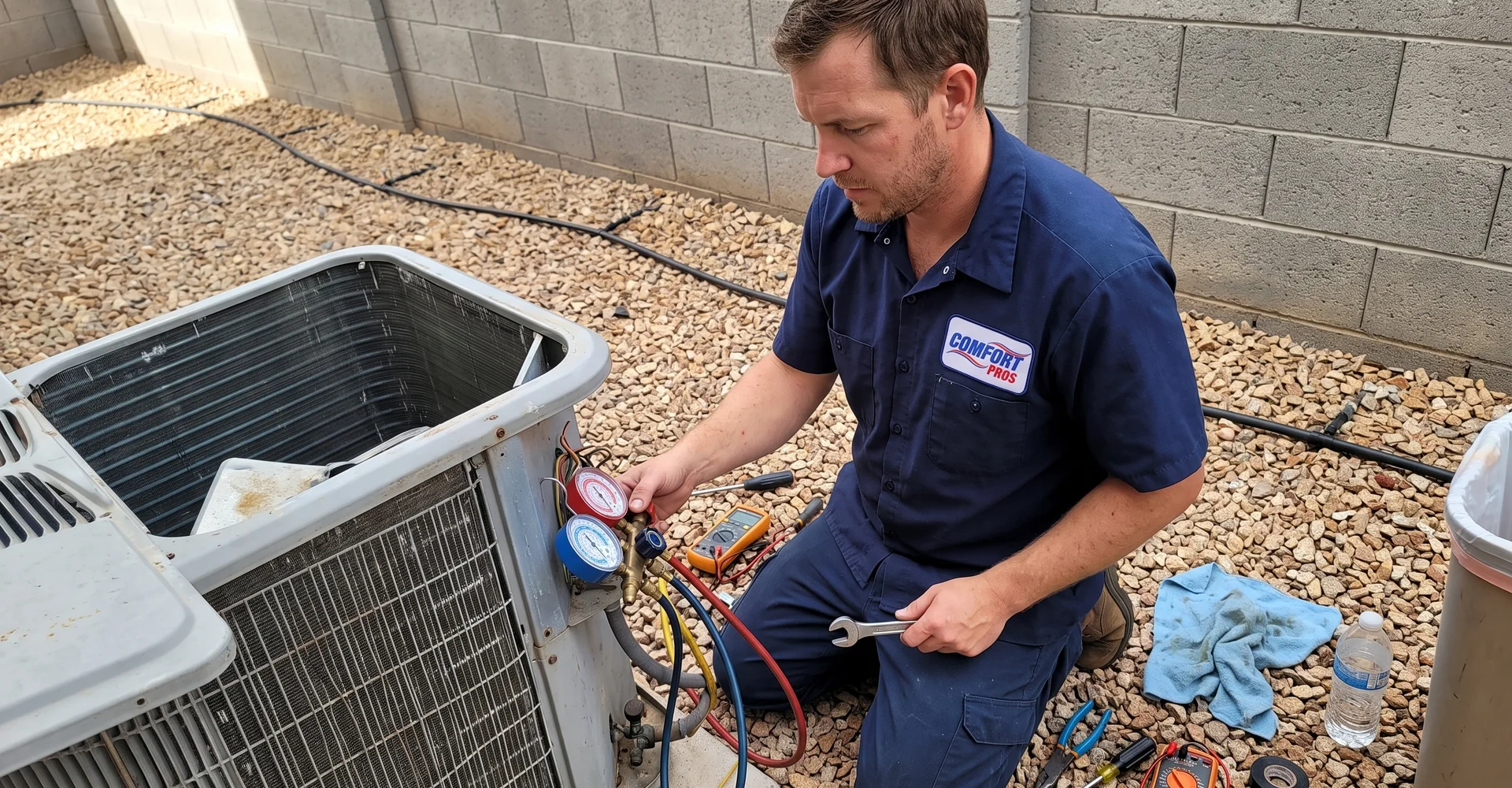
A diagnostic that consists of looking at the unit and putting gauges on it is a guess with a fee attached. Ours runs 45 to 60 minutes and produces measurements you can see:
- Electrical: capacitor tested under load, contactor condition, compressor and fan motor amp draw against nameplate
- Refrigerant: subcooling and superheat readings, which together reveal charge accuracy, metering device behaviour and airflow adequacy
- Airflow: static pressure testing across the air handler, because a system starved by undersized or leaking ductwork will fail again no matter what part gets replaced
- Condition: condenser coil fouling, evaporator coil frost or biological growth, condensate drain line clearance
That last one matters more than it sounds. A large share of the “my AC stopped working” calls we run in Mesa and Chandler trace back to duct systems that were undersized for the equipment installed on them. Replacing a part on a system that is being choked just resets the clock on the same failure.
Types of AC Repair We Handle
Electrical faults. Capacitors, contactors, relays, control boards and wiring. The most common category by a wide margin, and usually the cheapest to fix.
Refrigerant faults. Leaks at the coil, line set or service valves, undercharge, overcharge, and TXV failures. We locate the leak before adding refrigerant, because charging a leaking system is selling the same problem twice. R-410A pricing has risen through the R-454B refrigerant transition, so the honest cost conversation is different than it was a few years ago.
Airflow faults. Blower motor failure, seized bearings, blocked evaporator coils, collapsed flex duct and filters that have been in place since the last owner. Static pressure testing tells us which of these is really happening.
Compressor and mechanical faults. Scroll compressor failures, seized fan motors and hard-start conditions. These are the calls where warranty status matters most, and where we check the serial number before writing anything down.
Drainage faults. Blocked condensate drain lines, failed float switches and overflowing pans. Common, cheap, and responsible for a surprising amount of ceiling damage every summer.
Cost Guide: What Moves the Number
| Factor | Effect on price |
|---|---|
| Component involved | Capacitor and contactor work sits at the low end; coil and compressor work at the high end |
| Manufacturer warranty status | A covered part can turn a four-figure quote into labor only |
| Refrigerant type and charge required | R-410A costs have climbed through the R-454B transition |
| System accessibility | Rooftop package units and tight attic air handlers add labor time |
| Duct condition | A system failing because of restricted airflow needs the airflow fixed, not just the part |
| Time of year | Peak-season scheduling is tighter, though our rate card does not change |
We do not charge a different rate for an emergency, and we do not price differently by neighborhood. The flat rate is the flat rate.
When Do You Need AC Repair Rather Than Maintenance?
Some symptoms are maintenance items and some are failures in progress. Call for a repair if you are seeing any of the following:
- Air from the vents is warm, or noticeably less cold than it was a week ago
- The outdoor unit hums but the fan does not spin
- The system runs constantly and never reaches the thermostat setpoint
- Ice is visible on the refrigerant lines or the indoor coil
- The breaker has tripped more than once
- Water is pooling near the indoor unit
- There is a burning or electrical smell when the system starts
If instead the system is cooling normally and you simply want it checked before summer, that is our $27 Tru Tune-Up rather than a repair call. And if the diagnostic points toward replacement, the AC installation conversation starts with a real Manual J load calculation rather than a rule-of-thumb size.
Repair or Replace?
We show you the calculation instead of the conclusion. Age, refrigerant type, repair cost against replacement cost, warranty status, and whether the existing ductwork can support new equipment. A six-year-old system with an electrical fault is a repair. A fifteen-year-old system needing a compressor is a replacement. The interesting cases sit in between, and that is where an honest contractor is worth more than a cheap one.
If you are weighing that decision now, read AC repair vs replacement for the same framework we use in the driveway, or run TrueQuote AI to see what a correctly sized replacement would actually cost before anyone talks you into one.