
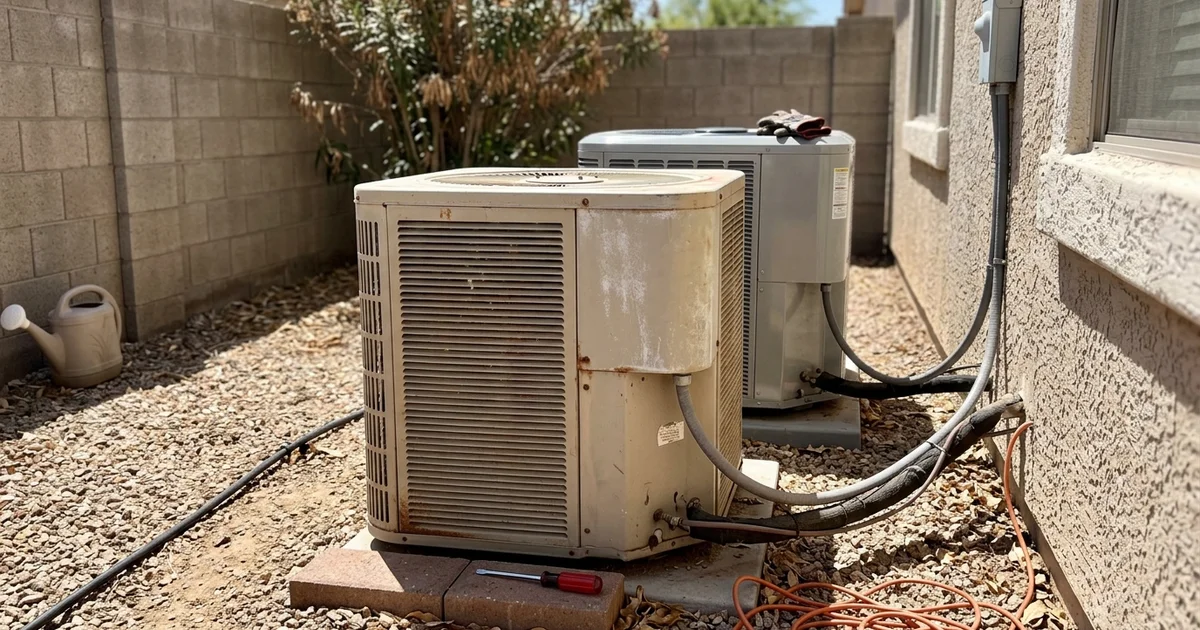
You know how everyone seems to have a hard-and-fast rule for an ac repair or replace decision? Most of those opinions are calibrated to a national average climate that does not describe Phoenix or the Antelope Valley. We at Comfort Pros AZ and CA see homeowners apply Midwestern logic to desert problems every day, and that mismatch often leads to bad financial decisions.
Let’s look at what the data actually tells us about equipment lifespans in extreme heat.
We will break down the true costs of keeping older units running and then explore a few practical ways to respond. Before getting into replacement math, you need to verify if the broken part is still under manufacturer warranty. Plenty of what looks like a four-figure disaster is actually a covered part plus labor, making it a genuine AC repair call rather than a replacement conversation.
The Thresholds That Actually Apply Here for AC Repair or Replace
The only threshold that matters in extreme Southwest climates is total compressor runtime. An air conditioner in our region reaches the end of its practical lifespan at 10 to 12 years, not the 15 to 20 years you see in national averages.
We operate on a simple observation regarding local weather patterns. An eight-month cooling season forces your system to survive roughly 3,200 annual cooling hours.
- Total cooling hours: Local systems run up to 3,200 hours annually.
- National average: Moderate climates average just 800 hours.
- Effective age: A 10-year-old local system has the wear and tear of a 30-year-old Midwestern unit.
Our technicians treat a twelve-year-old Phoenix unit like a twenty-year-old system anywhere else. Age thresholds that make sense in moderate climates are simply too generous here. Worth ruling out first, though: a system struggling to keep up during a heat wave is not automatically a system at the end of its life.
The Four Inputs
1. Age Against Runtime
Under eight years old, you should almost always choose to repair the unit. Between eight and twelve years, the decision depends entirely on the specific part failure.
We rarely see a major repair return its value on systems past twelve to fifteen years old. Knowing exactly when to replace air conditioner units in the Southwest depends heavily on this runtime factor. A compressor works exceptionally hard in this environment.
Sustained high-ambient operation accelerates wear faster than any other variable.
2. Repair Cost Against Replacement Cost
A repair approaching one-third of the replacement cost on aging equipment is money wasted on a depreciating asset. You can use the age-times-cost calculation as a baseline rule to evaluate this threshold.
We generally recommend replacement if your calculation exceeds 5,000. If you find yourself asking, ‘should I replace my AC?’, this formula provides immediate clarity based on two simple factors:
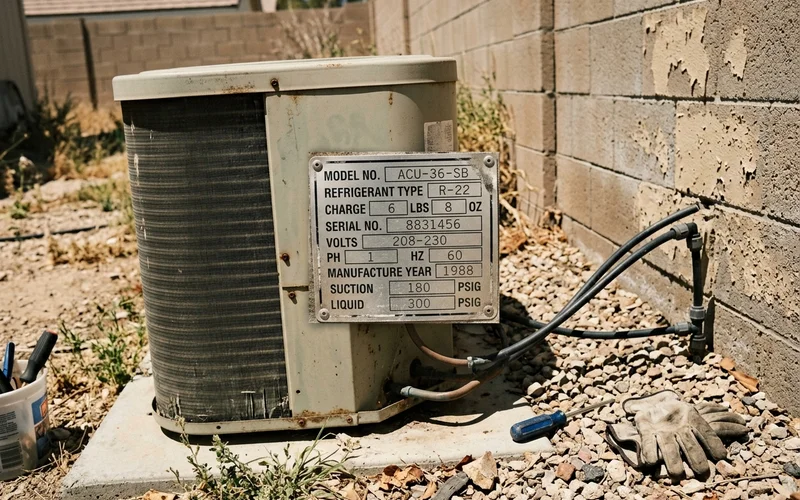
- Unit age in years: Verified from the manufacturer data plate.
- Repair estimate: The total out-of-pocket cost for parts and labor.
For context, replacing a compressor in Phoenix during 2026 costs between $2,200 and $4,000 due to high seasonal demand. Dropping that much cash into an old system rarely makes financial sense.
3. Refrigerant Type
An R-410A system needing a significant charge faces skyrocketing repair bills due to severe regulatory supply cuts in 2026. This shortage changes the arithmetic on repairs that were perfectly justifiable just three years ago.
We have watched wholesale R-410A prices surge, including a massive 60% jump in May 2026 alone. Homeowners now pay between $50 and $90 per pound for a standard recharge.
The ongoing refrigerant transition means finding parts like coils will only get more expensive. A major leak on an old system often justifies a full upgrade.
4. Available Efficiency Gain
Replacing an outdated single-stage unit with a modern system saves significant money across our long cooling season. The financial math completely changes if your current equipment falls far below modern standards.
We install systems that meet the strict 2026 minimum of 14.3 SEER2 for the Southwest region. Upgrading a decade-old 14 SEER unit to this new baseline yields immediate utility savings. Replacing a five-year-old high-efficiency system saves almost nothing because the gain is already banked.

The fifth input nobody mentions: your ductwork
If a static pressure test shows your duct system is restricting airflow, a new system will underperform in the same way the old one did. Sealing and insulating first sometimes reduces the equipment size the replacement needs, which partly pays for itself.
Where the Line Falls in Practice
Real-world decisions require looking at specific failures rather than general rules. The table below outlines exactly how specific repair scenarios stack up against replacement logic.
Our technicians use these exact benchmarks during service calls. Certain failures leave no room for debate.
| Situation | Honest answer |
|---|---|
| 6 years old, failed capacitor | Repair. Not close. The cost is minimal. |
| 8 years old, condenser fan motor | Repair. Check warranty first. |
| 10 years old, $600 repair, R-410A | Borderline. Score is 6,000. Look at efficiency gain and duct condition. |
| 12 years old, TXV or coil leak | Leaning replacement. R-410A costs make this prohibitive. |
| 14 years old, compressor failure | Replacement. Spending thousands on this asset is a bad idea. |
| Any age, cracked heat exchanger on the furnace side | Safety issue. Replace the affected appliance. |
| Any age, still under manufacturer warranty | Repair. Always run the serial number first. |
When We Tell You to Repair
You should repair any system under ten years old that holds subcooling correctly, passes a static pressure check, and needs an electrical component. A few hundred dollars spent on a simple fix is always a smart investment.
We say this often enough that it is worth stating plainly, because it runs entirely against the industry’s reputation for pushing new sales. Repairing good equipment remains the right call in several specific situations:
- Minor electrical faults: Simple components like capacitors or contactors are affordable fixes.
- Active warranties: Always use the manufacturer coverage before considering a swap.
- Short-term ownership: Buyers usually prefer to make their own equipment decisions.
- Rental properties: The economic model for income properties strongly favors maintenance over replacement.
We will never nurse a dying system just to string you along. If the diagnostic says the compressor is on its way out, knowing that in April is highly valuable. A hopeful repair that fails in July heat is a disaster.
Getting the Replacement Number Without a Sales Visit
You cannot make an informed financial decision without knowing the exact cost of a new system. Getting that number traditionally requires sitting through an in-home appointment with a high-pressure closer.
We remove that awkward barrier completely. The TrueQuote AI tool runs a real Manual J load calculation for your home instantly. It shows correctly sized equipment across efficiency tiers and provides real prices online in minutes. Our platform lets you hold that exact number next to your repair quote. You get to make the comparison yourself without anyone looking over your shoulder. Comparing your ac repair vs replacement cost requires actual local data.
If the math points toward a new unit, the AC installation and replacement guide covers what a properly commissioned job actually involves. Sometimes the numbers point straight back toward keeping your old unit running. We give that answer more often than people expect. Protecting your budget is the smartest way to earn your business for the long haul. Whether your final choice is an ac repair or replace route, having accurate data makes all the difference.