The Reason Yours Failed Early
Water heaters in Maricopa County do not usually die of old age. They die of water chemistry.
Municipal supply here runs 15 to 25 grains per gallon. As that water heats, dissolved calcium and magnesium precipitate out and settle as sediment on the bottom of the tank, directly over the burner in a gas unit. That layer insulates the burner from the water it is supposed to heat, so the burner runs longer and hotter for the same output. Gas consumption rises, tank steel gets stressed, and efficiency drops long before anything visible happens.
At the same time, the sacrificial anode rod, the component whose entire job is to corrode so your tank does not, is consumed far faster than the manufacturer’s life expectancy assumes. Once it is gone the tank steel itself begins corroding from the inside.
By the time you see water on the garage floor, that process has been running for years.
Which is why we would rather talk about hardness than sell you a third tank. If a softener is what stops the cycle, that is the honest recommendation.
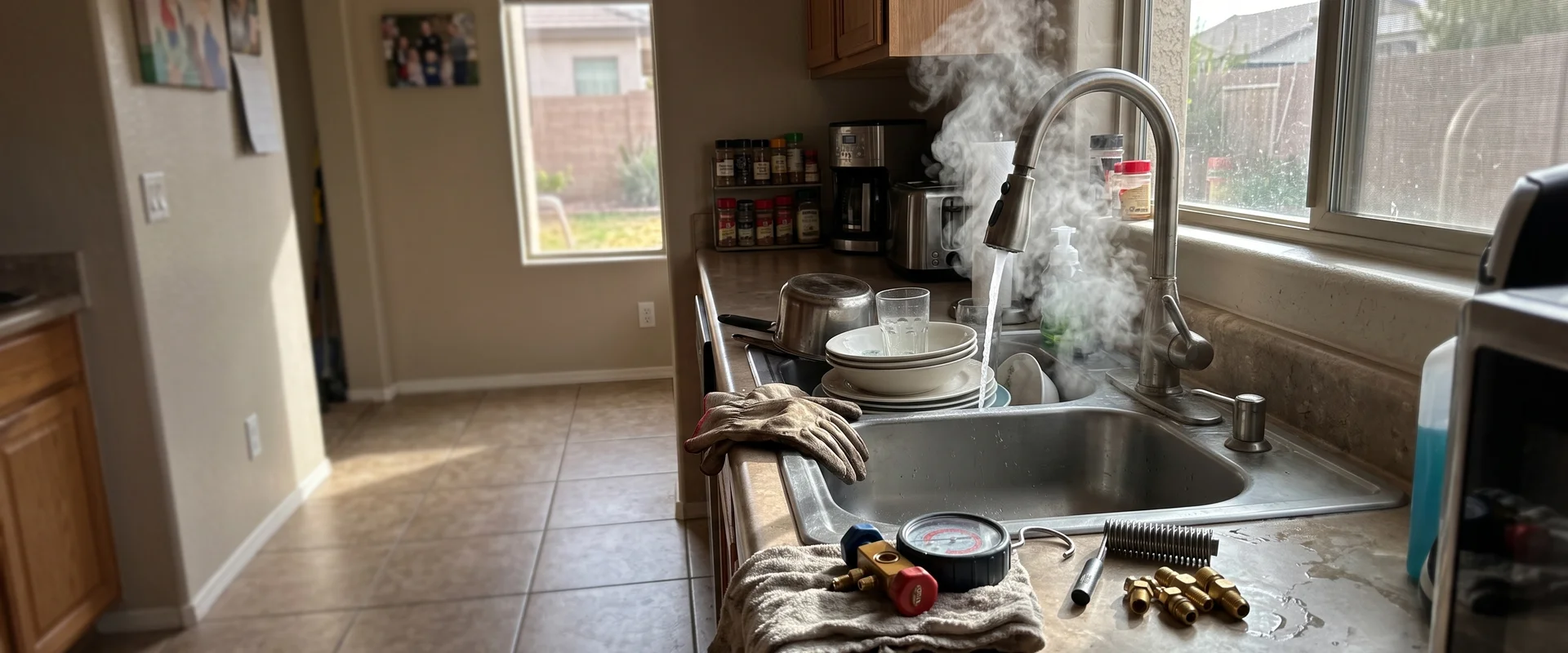
What “No Hot Water” Usually Means
It is rarely the tank itself. On a gas unit, the usual suspects are:
- Thermocouple or flame sensor. Fails to prove the pilot, gas valve closes. Common, cheap, fixable.
- Pilot assembly. Fouled or failed, particularly on units in dusty garages.
- Gas control valve. More expensive but a genuine repair on a tank with life left.
- Tripped ECO high-limit. Sometimes a reset, always worth finding out why.
On an electric unit:
- Upper or lower heating element. Produces partial heating or none. Inexpensive.
- Thermostat. Drifts or fails, same symptoms.
And on either:
- Broken dip tube. Cold water mixes at the top of the tank instead of the bottom, so you draw lukewarm water. Simple part, frequently misdiagnosed as a dead tank.
- Heavy sediment. Reduces effective tank volume, so hot water runs out faster than it used to.
The one situation that genuinely is not repairable is a tank weeping at a seam or fitting. At that point the steel has failed and nothing holds.
Tank vs Tankless, Honestly
| Tank | Tankless | |
|---|---|---|
| Installed cost | $1,600 - $3,200 | $3,500 - $6,500 |
| Service life | 8-12 years here, less in hard water | 15-20 years with descaling |
| Hot water supply | Limited by tank volume | Continuous, limited by GPM flow rate |
| Efficiency | Standing loss between draws | Higher UEF, no standing loss |
| Hard water maintenance | Annual flush | Annual descaling, non-negotiable |
| Footprint | Large, floor standing | Wall mounted, compact |
| Installation complexity | Straightforward swap | Gas line sizing, venting, condensate |
The honest summary: tankless is genuinely better for a household with high simultaneous demand and a long-term hold, provided you commit to descaling. For a small household replacing a working tank, the payback frequently does not arrive.
Maintenance That Actually Extends Life
- Annual flush on tanks, minimum, in our Arizona service area. Twice yearly is defensible in the hardest water. A tank never flushed in five years often cannot be recovered, because the sediment has cemented.
- Annual descaling on tankless units. Non-negotiable here. Isolation service valves make this a straightforward job, which is why we fit them at installation.
- Anode rod inspection every few years. A rod costs a fraction of a tank and replacing it at the right moment adds years. Almost nobody does this because almost nobody is told about it.
- T&P valve test annually. It is the safety device.
Code Items a Fast Swap Skips
Ask about these whoever you use:
- Expansion tank. Required on closed systems, prevents pressure spikes as water heats and expands.
- T&P discharge routing. Must terminate safely and correctly, not into a bucket or a wall cavity.
- Seismic strapping. Required in California, routinely omitted.
- Combustion air and venting. Particularly on a conversion or where the closet has been altered.
When It Is an Emergency
A tank that has let go can put a lot of water into a garage or a closet quickly. Close the cold supply valve at the top of the heater, then the main if that does not stop it, and turn off the gas or the breaker. Then call. Emergency plumbing covers what happens next.
For the deeper detail, why hard water kills Arizona water heaters and how often to flush a water heater go further than this page, and no hot water: pilot, thermocouple and element failures covers the diagnostics.