
The Interval That Actually Applies
Generic manufacturer guidance frequently suggests flushing every other year. That advice was not written for water at 15 to 25 grains per gallon.
Here the honest interval is annually at minimum, and twice a year is defensible on the hardest supply or in a heavy-use household. Water heater maintenance at that cadence is what keeps a tank near its rated life rather than well short of it.
There is a hard deadline hidden in this. A tank that has gone five years without a flush frequently cannot be recovered, because the sediment has consolidated into a hard layer that simply will not drain. At that point flushing produces a trickle of clear water and no benefit, and the damage is already accumulating.
What a Flush Actually Involves
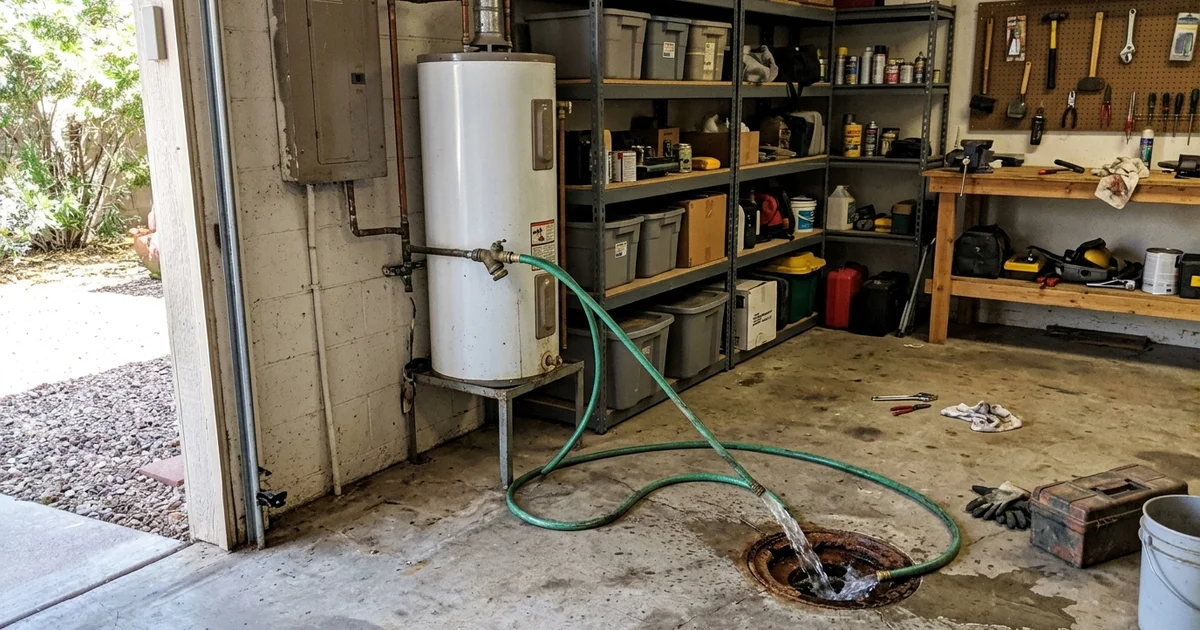
More than opening the drain valve, if it is being done properly:
- Shut off the heat source. Gas control to off or pilot, or the breaker off on an electric unit.
- Close the cold supply and attach a hose to the drain valve, running to a floor drain or outside.
- Open a hot tap somewhere in the house to break the vacuum so the tank drains.
- Drain and then flush. Draining alone leaves sediment behind. Cycling the cold supply on and off while the drain is open stirs the sediment and carries it out.
- Continue until the water runs clear, which on a neglected tank can take a while.
- Refill, purge air at a hot tap, and relight or re-energise.
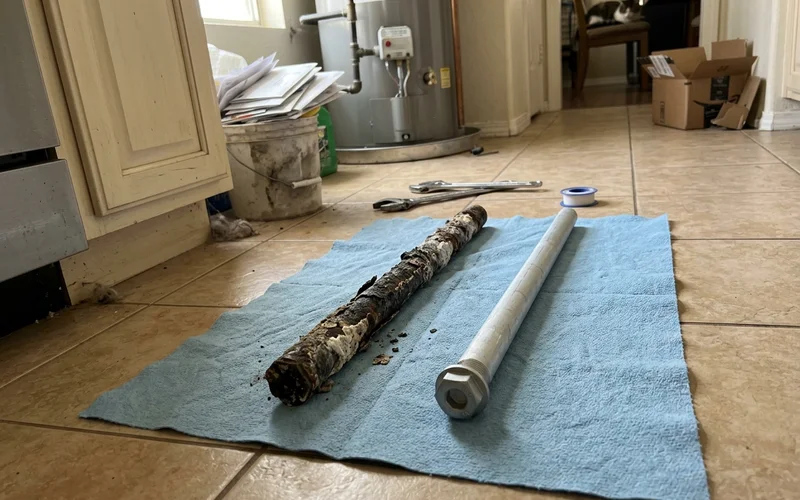
Anode rod inspection should accompany it periodically. The rod is unscrewed from the top of the tank and visually assessed. A rod consumed down to the core wire means the tank has been unprotected for some time, and replacing it costs a fraction of a new heater. Almost nobody has this done, because almost nobody is told it exists.
The popping sound is a deadline, not a quirk
Water trapped under sediment flashing to steam. Once you hear it, the layer is thick enough to be costing you efficiency every day.
Signs the Flush Is Overdue
| Sign | What it means |
|---|---|
| Popping or rumbling during heating | Sediment layer trapping water |
| Hot water runs out faster than it used to | Sediment reducing effective tank volume |
| Longer recovery between showers | Burner working through insulation |
| Rising gas bill with no rate change | Efficiency loss from sediment |
| Cloudy or gritty hot water | Sediment being carried into the supply |
| Never flushed, and you do not know its age | Book it now, before the layer cements |
Tankless Is a Different Job
Tankless units need descaling rather than flushing. A mild acid solution is circulated through the heat exchanger using a small pump and the isolation service valves, dissolving the scale that has formed in the passages.
Roughly annual in our water. The symptoms of an overdue descale are reduced flow rate, temperature fluctuation during a draw, and eventually manufacturer error codes.
This is why isolation service valves matter, and why we fit them at installation. A tankless unit installed without them turns a routine hour of maintenance into a much larger job, and the predictable result is that it never gets done.
Why This Is Worth Doing
Flushing is cheap, it takes under an hour, and it addresses the mechanism that actually shortens equipment life here. Hard water damage explains what is happening inside the tank and why a softener is often the more complete answer.
There is also a warranty dimension. Many manufacturers exclude scale-related failure, and documented maintenance is what demonstrates the equipment was cared for. Keep the records.