Why Desert Furnaces Fail on the First Cold Night
Heating equipment in our service area runs a handful of weeks a year. Homeowners reasonably assume that means it barely wears out. In practice it means something different: the system sits idle for ten months and is then asked to run hard, and a lot of components do not survive that transition gracefully.
That is why heating failures here cluster. The first genuinely cold night produces a week’s worth of no-heat calls in a single evening, and every technician in the valley gets booked at the same time. A fall heating check in October costs less than a December emergency and takes you out of that queue entirely.
The Antelope Valley is the exception. Palmdale and the high desert see genuine freeze cycles and real heating demand, which is the one part of our coverage where a dual-fuel hybrid system makes clear economic sense.
How We Diagnose a Heating Fault
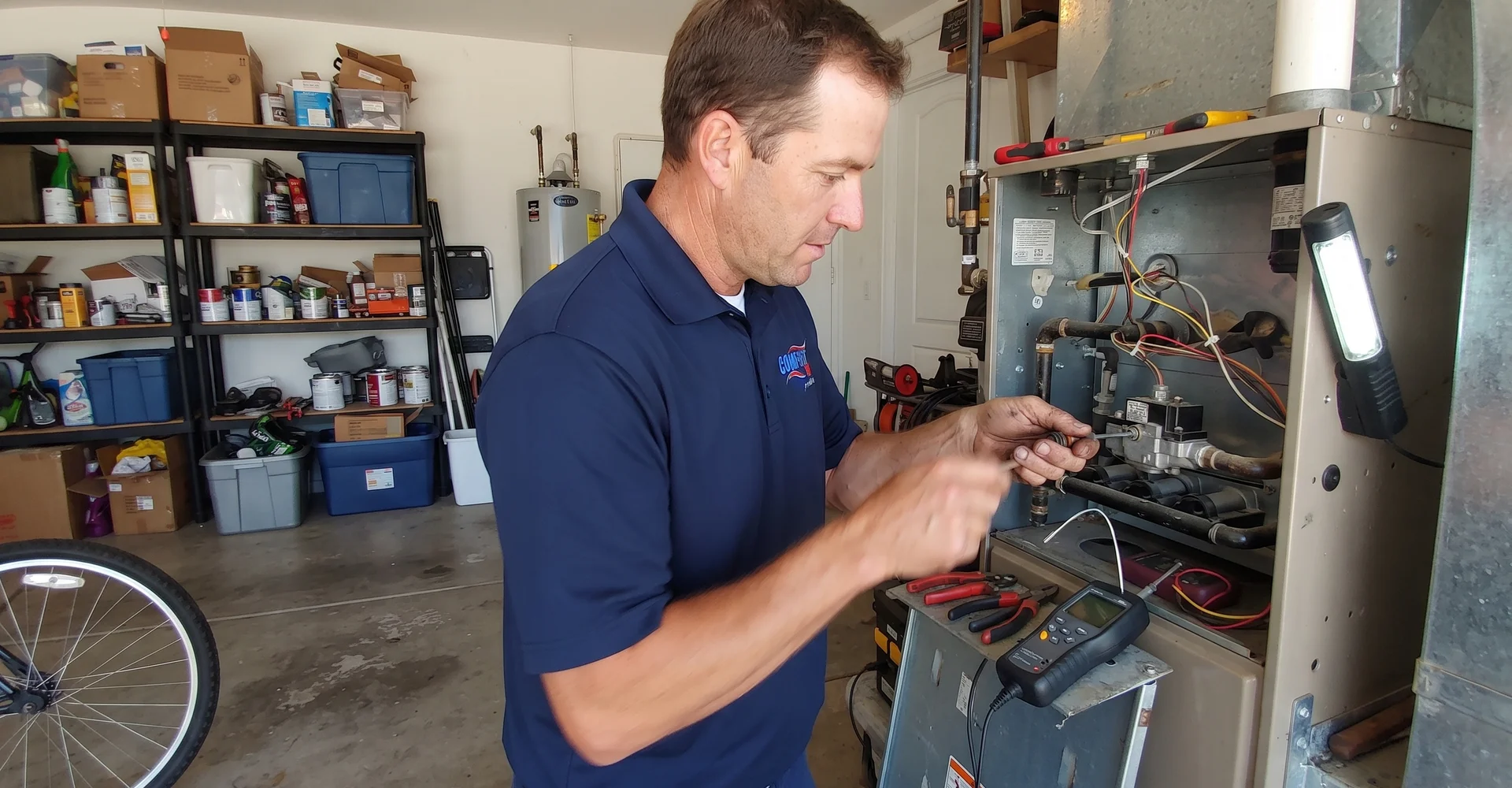
A gas furnace ignition sequence has a fixed order, and a failure almost always announces itself at a specific step. So we watch the whole sequence rather than swapping parts by likelihood:
- Call for heat. Thermostat closes the circuit.
- Inducer draft motor. Starts and establishes draft.
- Pressure switch. Proves the draft. A stuck or blocked switch stops the sequence here.
- Hot surface ignitor. Glows. A cracked or open ignitor stops it here.
- Gas control valve. Opens, burners light.
- Flame sensor. Confirms flame within a few seconds. A sooted sensor fails to confirm, the valve closes, and you get cold air from a running blower. This is the single most common fault we find.
- Blower. Engages after the heat exchanger warms.
- Limit switch. Watches for over-temperature. A tripping limit switch usually means restricted airflow rather than a bad switch.
Then, on every gas appliance, combustion analysis and a carbon monoxide reading, plus a heat exchanger inspection.
Types of Heating Repair We Handle
Ignition faults. Hot surface ignitors, flame sensors, spark igniters and control boards. The most common category and usually the cheapest.
Combustion air faults. Inducer draft motors, pressure switches, blocked flues and condensate blockages in condensing furnaces.
Gas train faults. Gas control valves, manifold pressure problems and multi-stage burner faults.
Safety faults. Limit switches, rollout switches and heat exchanger failures. This is the category where we occasionally recommend shutting an appliance down rather than repairing it.
Heat pump heating faults. Reversing valves and their solenoids, defrost boards and sensors, electric heat strip sequencers, and balance point settings that leave a system running on expensive auxiliary heat when the heat pump should be handling the load.
Airflow faults. Blower motors, capacitors and duct restrictions, all of which show up as heating symptoms even when the burner side is perfect.
Cost Guide
| Repair category | Typical range | Notes |
|---|---|---|
| Flame sensor clean or replace | $190 - $280 | Most common single fault we find |
| Hot surface ignitor | $240 - $380 | Carried on the truck |
| Pressure switch or limit switch | $260 - $420 | Often signals an airflow problem worth checking |
| Inducer draft motor | $520 - $780 | Warranty status matters here |
| Gas control valve | $580 - $950 | Combustion re-verified afterward |
| Heat pump reversing valve solenoid | $340 - $620 | Full valve replacement costs more |
The diagnostic starts at $89 and is credited toward the repair. Nothing gets touched before you have the flat-rate number.
When Repair Is Not the Right Answer
We will tell you to replace rather than repair when:
- The heat exchanger shows a crack or combustion analysis indicates a breach
- The furnace is over twenty years old and needs a major component
- Repeated short-cycling has caused cumulative thermal damage
- Repair cost approaches a third of replacement cost on ageing equipment
If that is where you land, furnace installation here is a different conversation than in a cold climate, because a six-week heating season changes the payback math on efficiency tiers. Our guide on furnace repair vs replacement walks through it.
And if what you actually have is a safety concern rather than a comfort one, cracked heat exchanger and carbon monoxide is worth reading before you run the system again.