
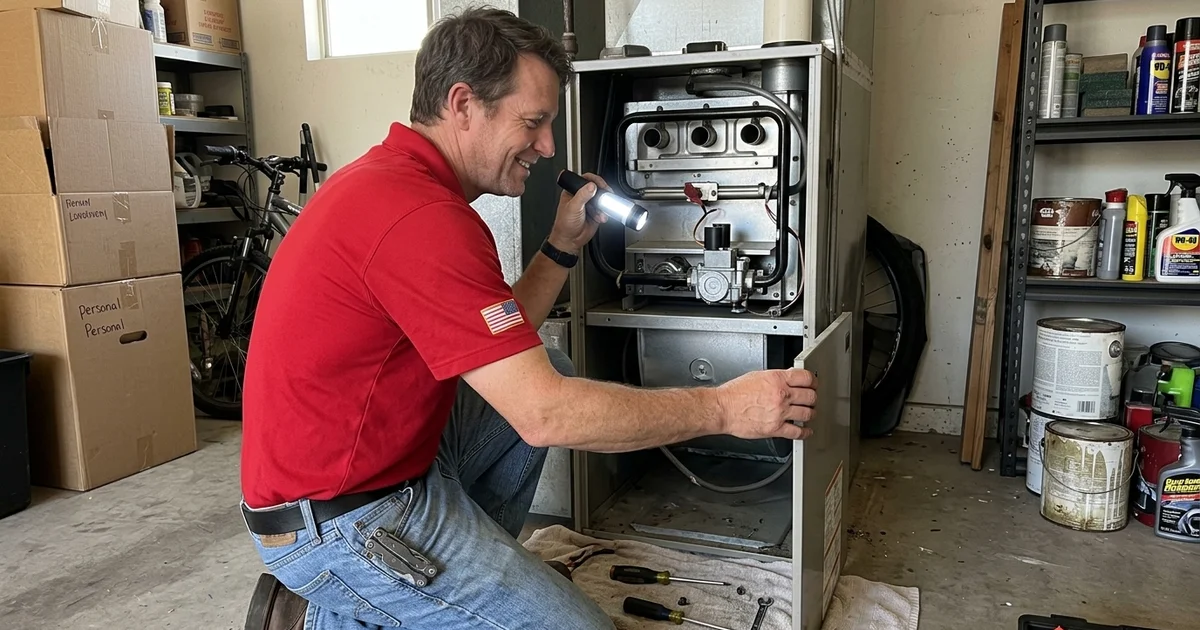
Start With the Free Check
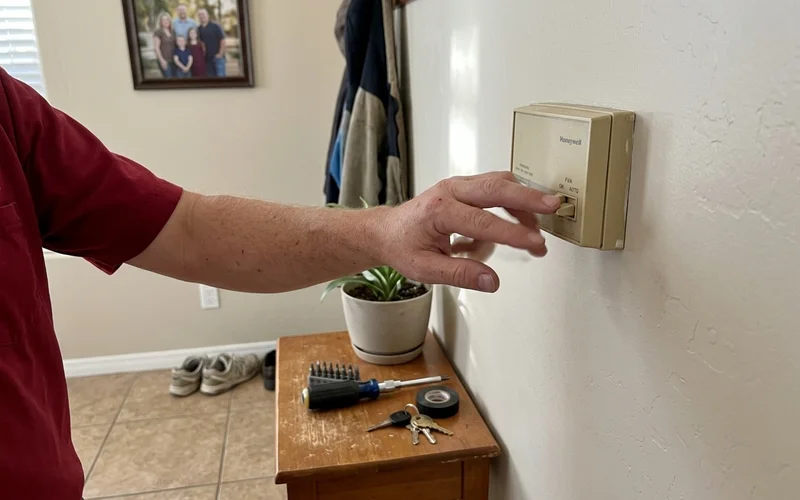
Before anything else, look at your thermostat fan setting.
If it is on ON rather than AUTO, the blower runs continuously whether or not the burner is firing. Between heating cycles you get air moving through ducts that may run through an unconditioned attic, and it feels cold because it is. Switch to AUTO and see whether the complaint disappears.
That accounts for a real share of “furnace blowing cold” calls and it costs nothing to rule out.
If the setting is already on AUTO, the fault is in the ignition sequence, and furnace repair is a same-day call. What follows is what is likely happening while you wait.
The Ignition Sequence, and Where It Fails
A gas furnace lights in a fixed order, and the failure almost always announces itself at a specific step:
- Thermostat calls for heat
- Inducer draft motor starts and establishes draft
- Pressure switch proves the draft
- Hot surface ignitor glows
- Gas valve opens, burners light
- Flame sensor confirms flame within a few seconds
- Blower engages once the heat exchanger warms
- Limit switch monitors for over-temperature
Step 6 is the most common failure we find. A flame sensor is a thin metal rod that detects flame via a tiny electrical current. It soots up over time, fails to confirm flame, and the control board closes the gas valve as a safety measure. The blower keeps running, delivering unheated air. That is the classic symptom.
Step 4 produces a furnace that tries repeatedly and never lights: a cracked or open hot surface ignitor.
Steps 2 and 3 stop the sequence before ignition ever begins: an inducer motor failing or a blocked pressure switch tube.
Step 8 produces short bursts of heat followed by cold air: a high limit switch tripping, almost always because restricted airflow from a dirty filter has let the heat exchanger run too hot.
Repeated lockouts are information, not bad luck
Each lockout means a safety circuit detected a real condition. Three lockouts in an evening is a fault getting worse, not a fluke.
What You Can Safely Check
| Check | Safe for a homeowner | What it tells you |
|---|---|---|
| Thermostat fan setting | Yes | ON vs AUTO explains a lot of calls |
| Air filter | Yes | A blocked filter trips the limit switch |
| Breaker | Yes | Furnaces have their own circuit |
| Gas valve position at the appliance | Yes, visually | Confirms supply is not isolated |
| Anything inside the burner compartment | No | Gas appliance, leave it |
| Bypassing or holding a safety switch | Absolutely not | This is how people get hurt |
Heat Pumps Are a Different Animal
If your system is a heat pump rather than a gas furnace, cold air has different explanations.
Defrost cycle. Normal. The system briefly reverses to clear frost from the outdoor coil, and indoor air can feel cool for a few minutes. Well-designed systems bring in auxiliary heat to mask it.
Reversing valve fault. The valve that switches between heating and cooling has failed or its solenoid has, leaving the system genuinely running in cooling mode. This one produces consistent cold air rather than brief cool air.
Auxiliary heat not engaging. On a cold morning the heat pump alone may not keep up, and if the auxiliary heat strips are not coming in, the house never recovers.
Balance point set wrong. On a dual-fuel system, the changeover to the gas stage may not be happening when it should.
When to Stop and Call
- The furnace has locked out more than twice in an evening
- You can smell gas at any point (leave the building, call the utility from outside)
- There is soot around the burner compartment or the flue
- The burner flame is yellow or wavering rather than steady blue
- A carbon monoxide detector has activated
- Anyone in the house has headaches or nausea that improve when they leave
Those last four move this from a comfort problem to a safety one. Heat exchanger safety explains why, and it is worth reading before running the system again.
Most heating faults, though, are an ignition component costing a few hundred dollars and finished in a single visit.