
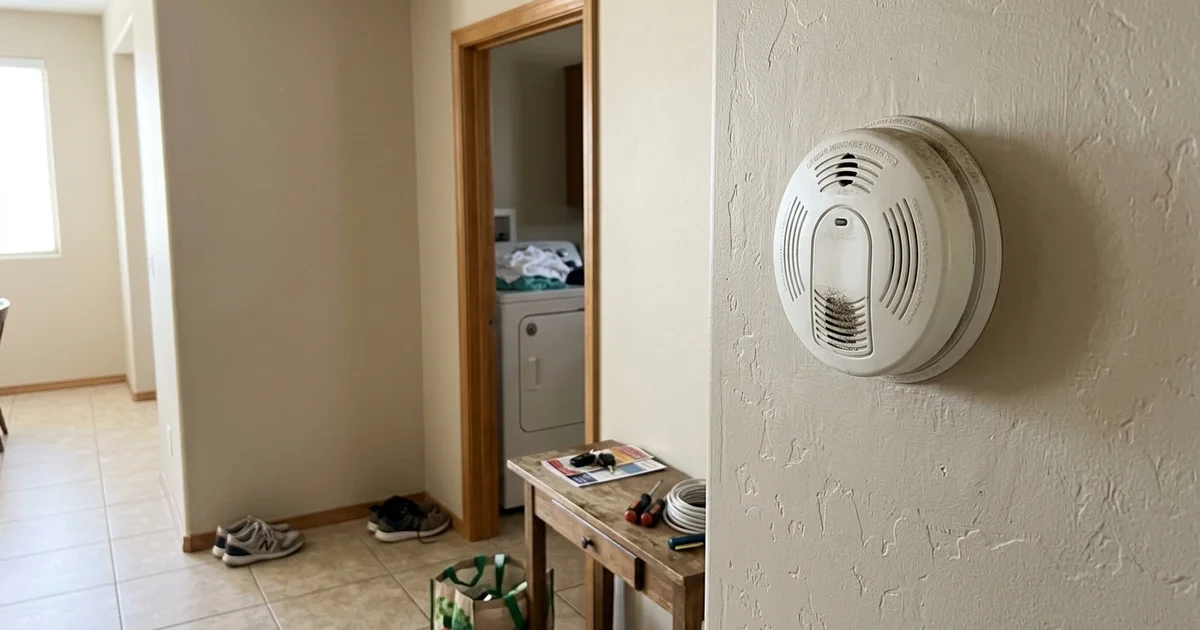
If You Suspect Carbon Monoxide Right Now
Do this first and read the rest afterward.
- Leave the building. Take everyone, including pets.
- Call from outside. Emergency services if anyone has symptoms, then the gas utility.
- Do not go back in to open windows, turn things off or collect anything. Ventilation is not a substitute for leaving.
- Do not reset the furnace or restart it to see whether the detector alarms again.
Carbon monoxide is colourless and odourless. A detector alarm is not a nuisance, it is the only warning the situation provides.
What a Heat Exchanger Is and Why a Crack Matters
Inside a gas furnace, combustion happens in a sealed metal chamber called the heat exchanger. Your house air passes over the outside of that metal, picking up heat, and combustion gases pass through the inside and out the flue. The two never mix.
That separation is the entire safety design.
When the metal cracks, combustion products including carbon monoxide can pass into the supply air and be distributed through every register in the house by the blower. It is the one furnace failure that is genuinely a safety issue rather than a comfort issue, and it is why every gas furnace repair and safety inspection we run includes combustion testing rather than treating it as an optional extra.
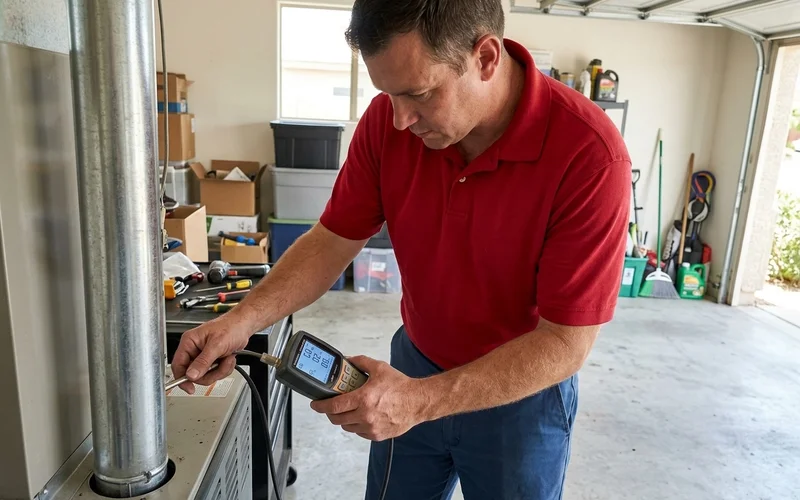
This is why every gas furnace visit we run includes CO testing
Combustion analysis and a carbon monoxide reading take minutes. Making them optional would mean charging separately for finding out whether the appliance is safe.
Why Lightly Used Desert Furnaces Still Crack
The intuition is reasonable: a furnace that runs six weeks a year should last forever. In practice, two things work against it.
Thermal cycling, not runtime, is what fatigues the metal. Every heating cycle expands the heat exchanger and every cool-down contracts it. That flexing accumulates as metal fatigue, and the number of cycles matters more than the total hours. A furnace that short-cycles produces far more cycles per hour of actual heating than one running steadily.
Short-cycling is common here. Restricted airflow from a neglected filter trips the high limit switch, shutting the burners down and restarting moments later. Oversized furnaces, which are common in a market where heating loads are small, do the same thing. Both produce exactly the cycle pattern that fatigues metal fastest.
Add twenty years of that and a lightly used furnace can be in worse condition than its hours suggest.
The Warning Signs
| Sign | What it may indicate | Urgency |
|---|---|---|
| CO detector alarm | Combustion products in living space | Leave immediately |
| Headaches or nausea improving when you leave the house | Possible CO exposure | Leave immediately |
| Soot deposits around the burner compartment or flue | Incomplete combustion | Stop using, call today |
| Yellow, wavering or lifting burner flame | Combustion problem | Stop using, call today |
| A strong chemical or formaldehyde-like smell when heating | Possible heat exchanger issue | Call today |
| Visible rust or corrosion on the heat exchanger | Deterioration in progress | Inspection needed |
| Repeated high-limit lockouts | Short-cycling causing thermal stress | Diagnose properly |
A steady blue flame with clean surroundings is what a healthy gas furnace looks like. Yellow, orange or lifting flames indicate incomplete combustion, which produces carbon monoxide as a by-product regardless of whether the heat exchanger has failed yet.
What a Combustion Test Involves
A combustion analyser samples flue gases and reports the composition, including carbon monoxide levels, oxygen, and combustion efficiency. Alongside that we inspect the heat exchanger visually where access allows, check the flue and venting for blockage or disconnection, and confirm adequate combustion air.
The result is data rather than an opinion, which matters when the conclusion is a recommendation to replace an appliance.
Why This Is Not a Repair
There is no sanctioned repair for a cracked heat exchanger. It is a sealed pressure component operating at high temperature with combustion on one side and breathing air on the other. Welding it, sealing it or fitting a liner does not restore that boundary reliably, and manufacturers do not support any of it.
If we find one, the honest recommendation is to shut the appliance down and replace it. We give that recommendation knowing it costs us the repair we were called for, and we would give it again.
Repair or replace covers the wider decision for furnaces that are ageing but safe, and furnace replacement explains what a sensible replacement looks like in a market with a six-week heating season.
For anything short of a safety finding, furnace repair and safety inspection handles it same-day, and most heating faults turn out to be an ignition component costing a few hundred dollars.
Two Things Worth Doing Regardless
Have working carbon monoxide detectors on every level of the house, including outside sleeping areas, and test them. They cost very little and they are the only warning this hazard gives.
And book the fall heating check. Combustion testing during a routine visit finds developing problems while they are still developing, which is the entire point.