Two Regions, Two Completely Different Air Problems
Indoor air quality work in our service area splits neatly along the state line, and the equipment that solves one problem does not automatically solve the other.
Arizona: dust load. A haboob puts an extraordinary volume of coarse particulate into the air, and it gets into everything. A filter that was fine last week is packed after one storm. A condenser coil loads enough to cost measurable cooling capacity. The problem is quantity, and the answer is surface area and frequency.
California: fine particulate. Wildfire smoke carries particles small enough to pass straight through a standard one-inch filter, which is why a house can smell of smoke with the system running. The problem is capture efficiency at very small particle sizes, and the answer is deep media filtration plus, in many homes, active whole-home purification.
Then there is the problem both regions share: biological growth on a permanently wet evaporator coil, which produces odour and degrades efficiency. That is what UV-C is genuinely for.
The Measurement That Comes First
Every recommendation on this page follows a static pressure reading, because filtration and airflow trade against each other and most homeowners have never been shown the trade.
A higher MERV rating captures more particulate and resists airflow more. Every blower has a limit to the resistance it can work against. Exceed it and airflow drops, cooling capacity falls, the evaporator coil can freeze, and the blower motor runs hot and fails early. The homeowner who buys the densest one-inch filter on the shelf believing it is the responsible choice is frequently doing real damage.
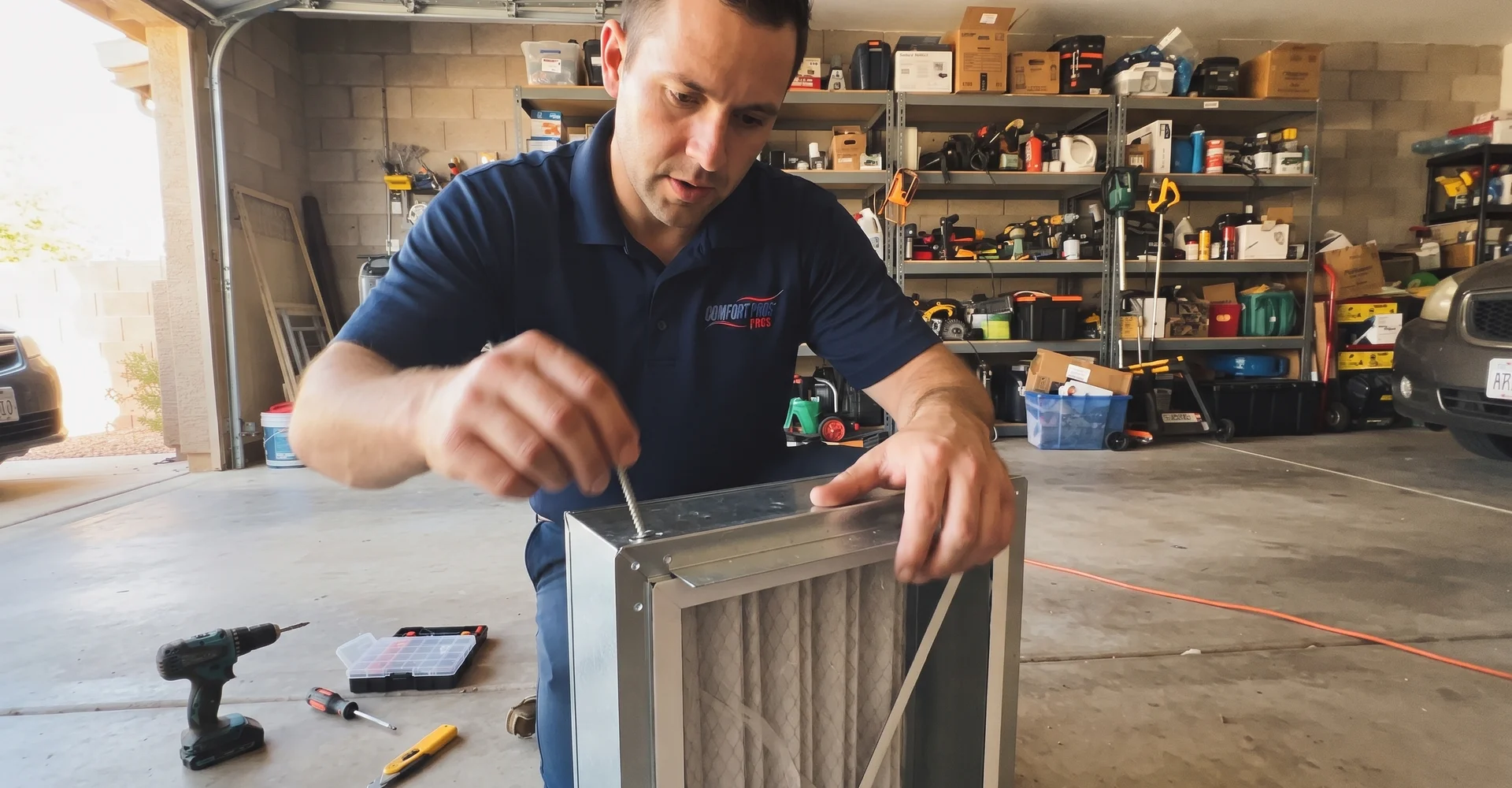
The structural fix is usually a four or five inch media cabinet in place of a one-inch slot. Far more surface area means high capture at low resistance, and replacement intervals measured in months rather than weeks. We measure static pressure before, size the cabinet against that number, and measure again afterward.
Types of Air Quality Equipment
Media filter cabinets. The single most useful upgrade in most homes. Four or five inches deep, high capture, low resistance, long intervals.
Whole-home air purifiers. Integrated into the ductwork and interlocked with the blower. Effective against fine particulate that filtration alone struggles with, which is why they matter during smoke season.
UV-C germicidal lamps. Positioned to illuminate the evaporator coil and drain pan, targeting biological growth on a wet surface. Effective for that. Not a particulate filter, and we will not sell it as one.
Smart thermostats. The air quality value is scheduled fan circulation, moving air through your filtration between cooling calls. During a smoke event when the cooling load is low, that is the difference between filtration that works and filtration that sits idle.
Humidity control. More relevant in coastal California than in the desert, and frequently a sizing problem in disguise: an oversized air conditioner that short-cycles leaves a house damp at temperature.
Cost Guide
| Upgrade | Typical installed range | Best for |
|---|---|---|
| Media filter cabinet | $450 - $1,200 | Almost every home, especially dust-heavy areas |
| UV-C germicidal lamp | $600 - $1,100 | Coil biological growth and associated odour |
| Whole-home air purifier | $1,200 - $2,200 | Smoke events, allergies, fine particulate |
| Smart thermostat | $350 - $650 | Circulation scheduling and time-of-use savings |
| Full package | $2,200 - $3,200 | Combining filtration, purification and controls |
Where the Bigger Win Usually Is
Before spending on air quality equipment, it is worth knowing that in a lot of Southwest homes the larger comfort and dust improvement comes from somewhere else entirely.
A leaky return pulls attic air, and attic dust, directly into your living space. That is not a filtration problem, it is a sealing problem, and no filter fixes air that enters downstream of it. Duct cleaning and sealing frequently does more for a dusty house than any purifier.
Similarly, if your system is oversized and short-cycling, humidity and comfort complaints trace back to sizing rather than air treatment. That points at AC installation with a proper load calculation instead.
For more detail, filtering dust storms, pollen and wildfire smoke and MERV, HEPA and UV-C air cleaners explained go through the options without the product marketing.