
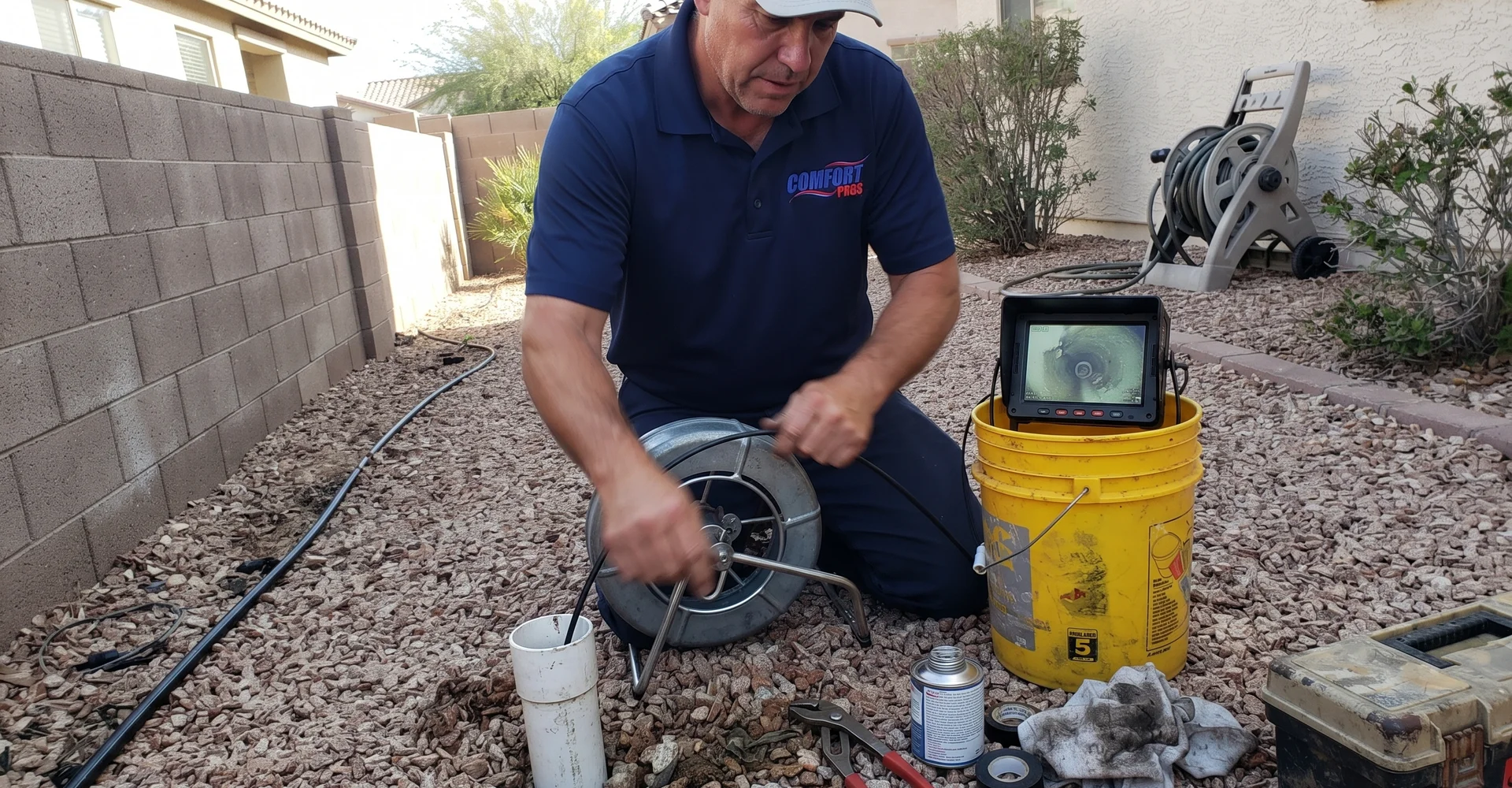
Plumber feeding a sewer camera into a cleanout with the monitor nearby
Same-Day Service

Sewer and Gas Line Repair: We Camera the Line Before We Quote It

Sewer repair and replacement, camera diagnostics, trenchless lining, and gas line repair and installation.

Licensed AZ & CA Flat-rate pricing 17 years in business
Get Your TrueQuote (480) 435-2334 From $ 295 camera inspection from $295, repair quoted after diagnosis
4.9 Rating
115+ Google reviews
Same-Day Service
Across AZ and CA service areas
Licensed & Insured
AZ ROC 364742 | CA C-20 #1040927
Flat-Rate Pricing
Quoted before work begins

What Brings People to Us for Sewer & Gas Lines

The situations behind most of these calls, and what we actually do about each one.

A five-figure sewer quote with nothing to look at

Somebody snaked the line, said the word collapse, and handed over an excavation price. There is no footage, no depth marked, and no way to judge whether it is true.

A recorded fiber-optic camera inspection comes first, with depth and location marked at the fault. You watch the footage with us before any repair is priced.

The driveway or the mature landscaping in the way

An open-cut replacement under a concrete drive or a forty-year-old tree turns a plumbing repair into a landscaping project, and West Valley caliche makes digging worse.

Where the pipe wall still supports it, cured-in-place lining seals root intrusion at every joint from the inside, with no trench across the yard.

Roots back in the same joint every couple of years

Clay laterals with mortar joints keep letting roots in. Each clearing buys a season, and the recurring bill quietly adds up to the cost of a real repair.

The camera tells us whether this is a jointed clay line, scaled cast iron or a bellied section, and each of those gets a different, permanent answer.

A gas smell nobody wants to touch

Gas work sits between trades. Plenty of plumbers will not do it, and a suspected leak means waiting while the utility shuts service off at the meter.

We repair, replace and install gas lines, pressure test the system and document the safety verification, with permits handled in both Arizona and California.

The Rule: Look Before Quoting

Six very different sewer problems produce the same symptom inside your house. Root intrusion at a clay joint. A belly holding water. An offset joint. Internal cast iron scale. A foreign object. A genuine collapse.

The correct repair for each one is different, and the price range across them spans an order of magnitude. So quoting without looking means either padding for the worst case or quoting low and revising upward once the work is underway. Neither is honest.

We run a fiber-optic camera through the cleanout first, record it, mark depth and location at whatever we find, and then watch the footage with you. That single practice removes most of the mistrust that surrounds sewer pricing, because you can see the thing you are being asked to pay for.

What We Find, and What Each One Needs

Root intrusion. Roots enter through joint gaps in older clay and cast iron laterals, drawn by moisture. Mature street trees in La Crescenta, Pasadena and older Los Angeles neighborhoods are the classic source. Cutting the roots clears the blockage and leaves the entry open, which is why the problem returns annually. Lining seals every joint at once and ends it.

Cast iron scale. Cast iron corrodes internally into a rough layer that narrows the pipe and catches everything passing. Central Phoenix and pre-1960 California housing are full of it. Snaking does nothing to the scale. Descaling mechanically removes it and restores diameter, frequently followed by lining.

Offset joints. Two sections shifted out of alignment, creating a lip that catches solids. Lining bridges it where the pipe wall is otherwise sound.

Bellies. A settled section that has lost its fall and holds standing water. Lining does not fix a belly because a liner follows the existing shape. This one genuinely requires excavation and re-laying to grade.

Collapse. No host pipe left to line. Excavation and replacement.

Trenchless vs Excavation

Trenchless liningExcavation
Typical cost$4,500 - $9,500$6,500 - $15,000
Surface disruptionMinimal, existing access pointsOpen trench, restoration required
Works whenPipe wall structurally intactCollapsed pipe, bellies, grade problems
Fixes root intrusionPermanently, seals all jointsYes, with new pipe
Effect on diameterSlight reductionNew pipe at full diameter
In caliche soilStrong advantageMeaningfully more expensive per foot
Duration1-2 days2-5 days

In the West Valley, caliche is the deciding factor more often than anywhere else we work. That cemented layer digs like soft rock, which pushes excavation cost up per foot and makes lining the obvious first thing to evaluate in Glendale, Peoria, Surprise and Goodyear.

We will still tell you to dig when digging is right. A belly cannot be lined and no amount of preference changes that.

Gas Line Work

Separate discipline, same crew licensing. We handle:

  • Repair of leaking or corroded gas lines
  • Replacement of ageing runs
  • New installations for ranges, pool heaters, fire pits, outdoor kitchens and tankless water heater conversions
  • Gas line sizing against actual BTU demand, which matters enormously on tankless conversions where an existing line frequently cannot deliver what the unit needs
  • Pressure testing and gas safety verification on every job
  • Permitting in both states

If you smell gas right now: leave the building, do not operate light switches or anything that could spark, and call the utility emergency line from outside. Call us for the repair once the situation is safe.

Permits and the Los Angeles Difference

Permitting is our job. That includes the City of Los Angeles, which handles sewer lateral repair permitting differently from surrounding jurisdictions and has its own requirements for work in the public right of way. Discovering a permit problem with an excavation already open is a bad afternoon, and it is entirely avoidable.

Before You Buy an Older House

A standard home inspection does not include the sewer lateral, and a failed lateral is a five-figure surprise. In pre-1960 Burbank and Pasadena housing, in central Phoenix, and anywhere with mature street trees, a pre-purchase camera inspection is close to essential and costs a fraction of what it can save.

If your immediate problem is a blockage rather than a structural fault, drain cleaning and hydro jetting is the faster route, and if water is actively backing up into the house, emergency plumbing gets you a same-day truck.

For deeper reading, sewer camera inspection explained, trenchless pipe lining vs excavation and gas line leak warning signs cover each area properly.
How Much Does Sewer & Gas Lines Cost?

Nobody should quote a sewer repair without seeing inside the pipe. The camera inspection is the first step and everything else follows from what the recording shows.

Camera inspection

Recorded, with the footage explained to you

From $295
  • Fiber-optic camera through the cleanout
  • Depth and location marked at the fault
  • Recording provided, not just described
  • Credited toward the repair where you proceed
Get exact pricing
Most chosen

Trenchless lining

Cured-in-place lining where the pipe wall allows

$4,500 - $9,500
  • No driveway or mature landscaping torn up
  • Seals root intrusion at every joint permanently
  • Restores a smooth interior on scaled cast iron
  • Ideal in West Valley caliche where digging is expensive
Get exact pricing

Excavation and replacement

Where the line has genuinely collapsed

$6,500 - $15,000
  • Full open-cut replacement in new PVC
  • Caliche and rocky soil handled properly
  • Permits managed in both AZ and CA
  • Surface restoration included in the quote
Get exact pricing

Financing available

GreenSky, Wisetack and Goodleap, so you can pick the lender that fits your credit profile. Where your equipment qualifies for a utility rebate, it stacks with financing.

Compare options

Why Choose Us for Sewer & Gas Lines?

We record the inspection

You get to see what is in your pipe rather than take our word for it. That single practice removes most of the mistrust around sewer pricing.

Trenchless where it genuinely fits

In West Valley caliche, excavation is expensive because the ground digs like soft rock. Lining an intact pipe avoids that entirely.

We dig when lining would be wrong

A collapsed line cannot be lined. We will tell you that even though excavation is the harder sell and the harder job.

Cast iron descaling capability

Central Phoenix and older Los Angeles neighborhoods run cast iron laterals that scale internally. Descaling restores diameter that snaking never touches.

Gas line work with proper testing

Repair, replacement and new installation, with pressure testing and gas safety verification. Not something to have done casually.

Permits handled in both states

Including City of Los Angeles lateral-repair permitting, which differs from surrounding jurisdictions and is our job, not yours.

How Our Sewer & Gas Lines Works

1

Camera first

A fiber-optic camera through the cleanout, recorded, with depth and location marked at whatever we find. No quoting from symptoms.

2

Watch it with you

Root intrusion, a belly, an offset joint, cast iron scale. You see the footage and understand what you are paying to fix.

3

Line or dig, honestly

Where the pipe wall is intact, trenchless lining avoids opening your driveway. Where it has collapsed, we excavate. The recording decides, not the invoice.

4

Repair, test and restore

Work completed, line re-cameraed to verify, permits closed out, and the surface restored properly.

Still deciding on Sewer & Gas Lines?

Flat-rate pricing quoted before we start, parts and labor warranty on the finished work, and an honest answer if you do not need it yet.

Recent Sewer & Gas Lines Jobs

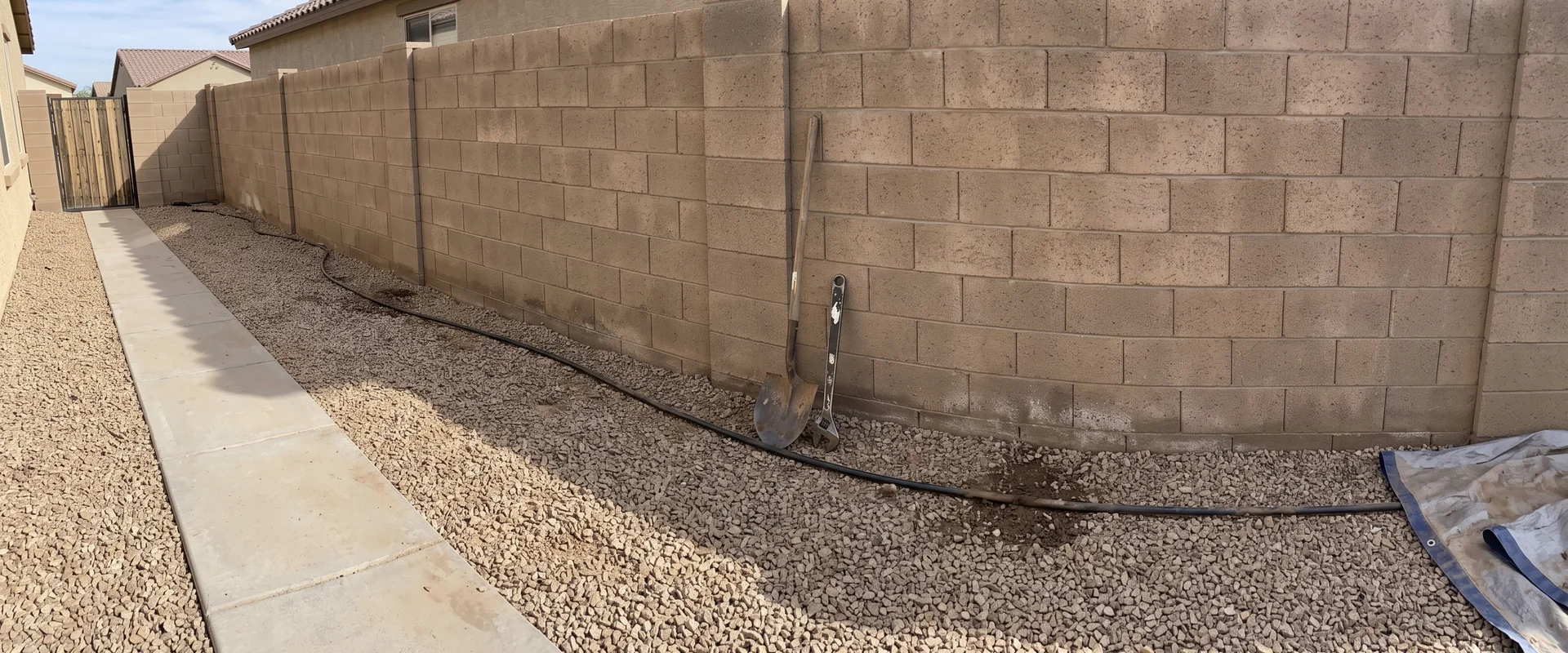
Click any photo to enlarge.

How Comfort Pros AZ and CA Compares

What matters Typical provider Comfort Pros
Diagnosis before quoting Quoted from symptoms Recorded camera inspection first
Recording provided Described verbally Footage shown and provided
Trenchless option Excavation by default Lining wherever the pipe wall allows
Cast iron scale Snaked repeatedly Descaled or lined to restore diameter
Permitting Left to the homeowner Managed in both AZ and CA
Post-repair verification Not performed Line re-cameraed after the work

What Customers Say About Our Sewer & Gas Lines

4.9 from 115+ Google reviews
Third plumber we called about a recurring kitchen clog. First two just snaked it and left. Comfort Pros ran a camera, found grease buildup halfway down the line, jetted it properly, and it hasn't backed up since.
M Marcus T. Mesa, AZ
Roots at every joint on an old clay lateral. They lined it instead of digging up the front garden, which is exactly what we were dreading.
L Linda & Steve G. Burbank, CA
They showed me the camera footage before quoting anything. First time a plumber has ever done that for us.
R Rachel M. Gilbert, AZ

Sewer & Gas Lines FAQs

Why do you insist on a camera inspection first?

Because the symptoms of six very different sewer problems are identical from inside the house. A slow drain or a backup could be root intrusion at a clay joint, a belly where the line has settled and holds water, an offset joint where two sections have shifted, internal scale narrowing a cast iron pipe, a foreign object, or a genuine collapse. Each of those has a different correct repair, and the price range across them spans an order of magnitude. Quoting without looking means either guessing high to cover the worst case or guessing low and revising upward once work starts. A recorded camera inspection removes the guessing entirely, and you get to watch it, which means you understand what you are paying to fix rather than trusting a description.

What is trenchless sewer lining and when does it work?

Cured-in-place pipe lining installs a resin-saturated liner inside your existing pipe and cures it in place, creating a continuous jointless pipe within the old one. Because it goes in through existing access points, it avoids opening a driveway, a mature landscaped garden or a slab. It works where the host pipe still has structural wall integrity, even if the joints have failed and roots are entering. It seals every joint permanently, which is the definitive fix for root intrusion, and it restores a smooth interior on scaled cast iron. It does not work where a line has genuinely collapsed, because there is no host pipe left to line, and it slightly reduces internal diameter, which matters on already-marginal pipe sizes.

How much does sewer repair cost?

The camera inspection starts at $295 and is credited toward the repair. Trenchless cured-in-place lining typically runs $4,500 to $9,500 depending on length and access. Open-cut excavation and replacement runs $6,500 to $15,000, driven by length, depth, soil conditions and what has to be restored on the surface. In the West Valley, caliche soil pushes excavation costs up meaningfully compared to the same trench length in softer ground, which is precisely why trenchless is worth evaluating first here.

Why does caliche make excavation expensive?

Caliche is a cemented calcium carbonate layer that sits under much of the West Valley, and it behaves more like soft rock than soil. Hand digging through it is slow and physically brutal, and machine excavation needs heavier equipment and more time per foot than the same depth in ordinary soil. That is a real cost difference on any trench, and it is the practical reason trenchless methods deserve serious consideration in Glendale, Peoria, Surprise and Goodyear before anyone gets a shovel out.

What is cast iron descaling?

Cast iron sewer pipe corrodes from the inside as it ages, and the corrosion products build into a rough scale layer that narrows the effective diameter and catches everything passing through. Central Phoenix, older Los Angeles neighborhoods and pre-1960 California housing are full of it. Snaking a scaled line punches a channel through whatever is caught on the scale and leaves the scale itself completely untouched, which is why the same drain backs up again months later. Descaling uses a chain flail or a specialised cutting head to mechanically remove the scale layer and restore something close to the original diameter. It is frequently paired with lining afterward, because a descaled cast iron pipe with a fresh liner is effectively a new pipe.

How do roots get into a sewer line?

Through the joints. Older clay and cast iron laterals are made of relatively short sections joined at intervals, and as the ground moves and the joint material ages, tiny gaps open. Tree roots detect the moisture and nutrient gradient and grow toward it, entering through the gap and then expanding inside the pipe where conditions are ideal. Mature street trees in La Crescenta, Pasadena and older Los Angeles neighborhoods are the classic cause. Cutting the roots clears the immediate blockage and leaves the entry point open, which is why the problem returns on roughly the same schedule every year. Lining seals every joint at once, which is why it is the permanent fix rather than a repeat service.

Do you do gas line work?

Yes: repair, replacement and new installation, including runs for a new range, a pool heater, a fire pit, an outdoor kitchen or a tankless water heater conversion. All gas work includes pressure testing and gas safety verification, and permits are handled as part of the job. Gas line sizing matters more than people expect, particularly for tankless conversions where a unit's BTU demand can exceed what an existing line can deliver.

What are the warning signs of a gas leak?

The added odorant, which smells of sulphur or rotten eggs, is the primary one. Also a hissing sound near a line or appliance, dead or discoloured vegetation in a line path outdoors, an unexplained increase in gas usage, and physical symptoms like headaches or dizziness that improve when you leave the house. If you smell gas strongly, leave the building, do not operate light switches or anything else that could spark, and call the utility emergency line from outside. Then call us for the repair once it is safe.

Who handles the permit?

We do, in both states. That includes the City of Los Angeles, which permits sewer lateral repair differently from surrounding jurisdictions and has additional requirements for work in the public right of way. Permitting is our job, not something for you to discover once an excavation is already open.

How long does a sewer repair take?

A camera inspection is typically an hour to ninety minutes. Trenchless lining is usually one to two days including preparation, cleaning and curing. Open-cut excavation and replacement runs two to five days depending on length, depth, soil and surface restoration. We give you a realistic schedule after the inspection rather than an optimistic one before it.

What is a pipe belly and can it be fixed?

A belly is a section where the line has settled and lost its downward slope, creating a low point that holds standing water and solids. It causes recurring backups that snaking clears temporarily and never resolves. Lining does not fix a belly, because a liner follows the existing shape including the sag. Correcting one requires excavating that section and re-laying it to proper grade, which is one of the situations where excavation genuinely is the right answer.

Should I get a sewer inspection before buying a house?

In older housing, it is one of the best value inspections available. A standard home inspection does not include the sewer lateral, and a failed lateral is a five-figure surprise. In pre-1960 Burbank and Pasadena housing, in central Phoenix, and anywhere with mature street trees, we would consider it close to essential.

Still have a question?

Call the team in your state and talk to someone who actually works on these systems.

Same-day appointments available

Ready to Book Sewer & Gas Lines?

Flat-rate pricing quoted before we start, and an honest answer about whether you actually need this service. Same-day appointments available across Arizona and California.

Flat-rate pricing, no upsells Parts and labor warranty Licensed in AZ and CA

California team: (818) 690-7951 · Text us: (818) 489-2826