
Why This Comes First
Six very different sewer problems produce identical symptoms inside your house. A slow drain or a backup could be root intrusion, grease, cast iron scale, a belly, an offset joint or a genuine collapse.
Each of those has a different correct repair, and the price range across them spans an order of magnitude. So quoting without looking means either padding for the worst case or quoting low and revising once work begins.
Running a camera first removes the guessing, and because you watch the footage, it removes most of the mistrust that surrounds sewer line services pricing.
How the Inspection Runs
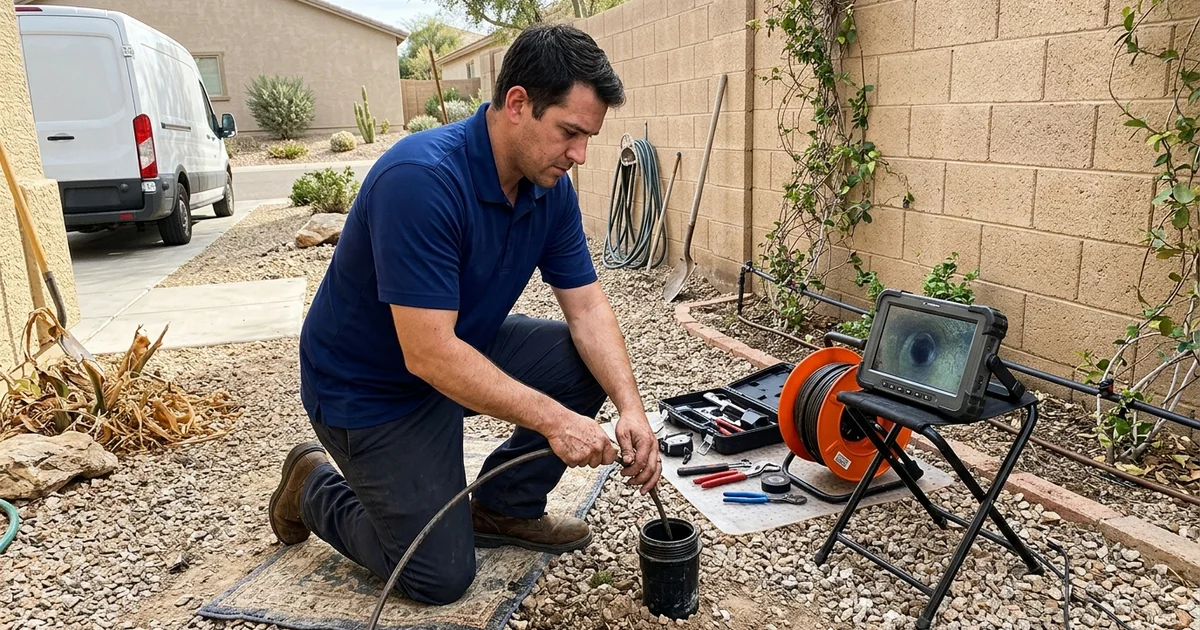
A fiber-optic camera on a flexible push rod goes in through the cleanout, which is a capped access pipe usually located in a side yard or against the house.
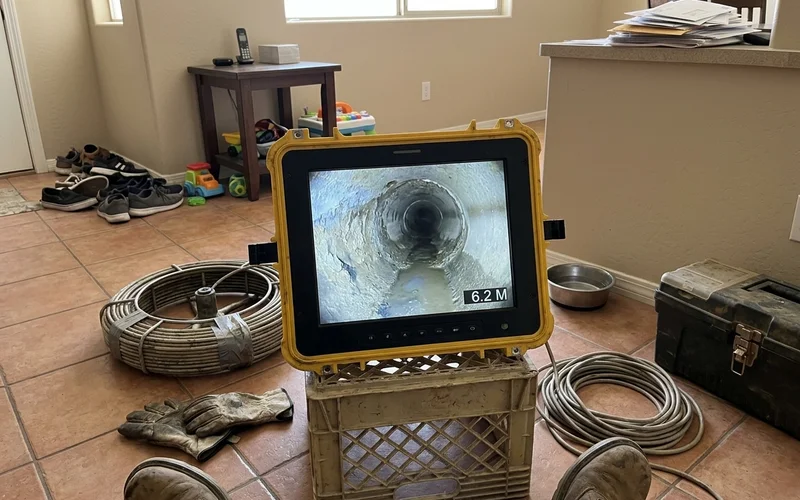
The camera feeds live video to a monitor with a footage counter, so every finding has a distance attached. Many systems also include a sonde, a transmitter in the camera head that lets a locator above ground pinpoint the camera’s position and depth. That is how a repair can be planned to open the ground at exactly the right spot rather than approximately.
The run continues to the municipal connection or until an obstruction stops it, and the whole thing is recorded.
You get the recording
Not a description. The footage, with depths marked, whether or not you hire us for the repair.
What Each Finding Looks Like, and What It Needs
| On screen | What it is | Correct repair |
|---|---|---|
| Fine roots at a joint, hair-like | Early root intrusion | Jetting now, lining as the permanent fix |
| Dense root mass filling the pipe | Established intrusion | Jetting or cutting, then lining |
| Rough orange-brown interior, narrowed bore | Cast iron scale | Descaling, frequently followed by lining |
| Standing water the camera travels through | A belly, settled section | Excavation and re-lay to grade. Lining will not fix it |
| A visible step or lip between sections | Offset joint | Lining if the wall is sound, excavation if severe |
| A dark gap, soil or void visible | Collapse or break | Excavation and replacement |
| Grease coating the wall, pale and thick | Grease accumulation | Hydro jetting |
The distinction between a belly and everything else matters most, because a belly is the one finding where trenchless lining genuinely cannot help. A liner follows the existing shape of the pipe, sag included.
How the Finding Maps to a Quote
This is the useful part. Once we know what is in the pipe:
- Roots at joints, sound pipe wall points at cured-in-place lining, which seals every joint at once and ends the annual backup cycle.
- Cast iron scale points at descaling to restore diameter, often followed by lining.
- Grease points at hydro jetting plus a conversation about kitchen habits.
- A belly or severe offset points at excavation of that section.
- A collapse points at excavation and replacement.
Trenchless versus excavation covers the two major repair paths in more detail, including how caliche soil in the West Valley pushes the arithmetic toward trenchless.
When It Is Worth Doing Preventively
Before buying an older house. The single highest-value application. Standard home inspections skip the lateral entirely.
After the second clog in the same line. A drain that has been cleared twice has a cause, and clearing it a third time is a subscription rather than a repair. Recurring clogs covers the patterns.
Before a major landscaping or hardscaping project. Finding out your lateral needs work after the new driveway is poured is an expensive sequence.
On a property with mature street trees and an older lateral, periodically, because root intrusion is progressive and cheaper to address early.