Why Phoenix and LA Water Is Treated Differently
Municipal supply in both of our service areas carries meaningful hardness, and that hardness is the most common reason plumbing equipment fails early, fixtures scale visibly, and soap never really rinses. Maricopa County supply runs 15 to 25 grains per gallon. Los Angeles County supply ranges widely but commonly lands in the 8 to 18 grain range, with chloramine or chlorine added for disinfection.
Hardness is not the only concern. Chlorine and chloramine affect taste and drying on skin and hair. Total dissolved solids affect the taste of coffee, tea and ice, and the long-term stability of plumbing downstream of an RO. Sulfur, iron and manganese show up in pockets and need their own treatment.
The through-line is that the right system depends on what is actually in the water and what you want it to do. We test hardness, TDS, chlorine and pH at every quote, recommend what the test actually says, and tell you when treatment is oversold.
Whole-House Filtration
A whole-house filter sits on the main line where water enters the home, so every tap gets treated water.
- Sediment pre-filter. Removes sand, silt and rust before they reach fixtures and appliances. The first line of defense and the stage that protects everything downstream.
- Carbon tank. Reduces free chlorine across the whole house. Better-tasting water at every tap, less drying of skin and hair in the shower, and protection of RO and other point-of-use systems downstream.
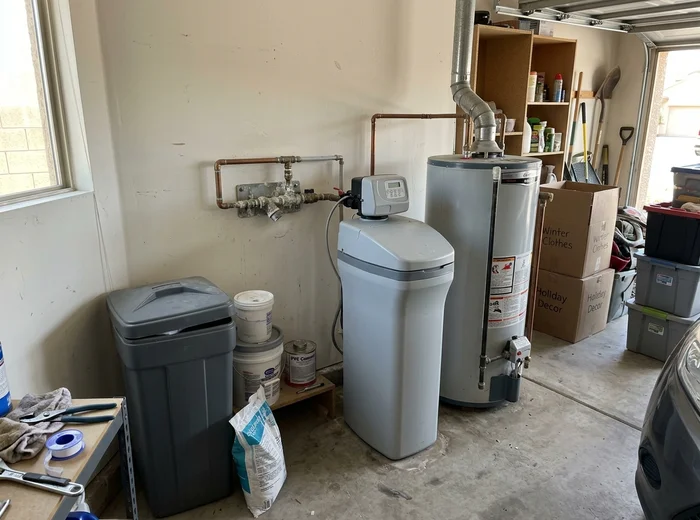
These can be combined with a softener or conditioner on the same loop, with bypass valves so the system can be isolated for service without shutting off water to the house.
Salt-Based Water Softeners
A salt softener actually removes hardness. Ion exchange swaps calcium and magnesium for sodium or potassium, dropping the hardness reading at every tap from 15 to 25 grains per gallon to less than 1. The result is soft water that does not scale water heaters, fixtures or glass, and that lathers soap properly.
What it requires is salt, a brine tank, a working drain and a periodic regeneration cycle. A properly sized unit for a typical home runs about 40 to 60 pounds of salt a month, regenerates two or three times a week, and uses about 30 to 50 gallons of water per cycle. We size to your actual household demand rather than over- or undersizing, which keeps salt and water waste closer to the minimum.
If you are on a sodium-restricted diet, potassium chloride can be used in place of salt. We can also bypass the kitchen cold line so cooking water comes off the main untreated.
Salt-Free Water Conditioners
A salt-free conditioner does not remove hardness. It changes the form of calcium and magnesium so the minerals are less likely to deposit as scale on fixtures, heating elements and glass. The hardness reading will still be high after the unit, because the minerals are still in the water. What changes is the visible scale on faucets and inside the water heater, and that is the actual goal of the system.
The technology is usually template-assisted crystallization (TAC). It requires no salt, no brine tank, no electricity and no drain. For households that would rather not deal with salt maintenance, it is the right answer when the goal is scale prevention rather than soft water.
If you want soft-feeling water with no soap scum, a salt softener is the right answer. If you want scale prevention with no salt, a salt-free conditioner is the right answer. We install both and tell you when one is over- or under-engineered for the actual situation.
Reverse Osmosis
Reverse osmosis pushes water through a semi-permeable membrane under pressure, removing 95 to 99 percent of dissolved solids. The result is noticeably cleaner drinking and cooking water, especially when the supply runs high in TDS or carries noticeable chlorine, sulfur or metallic off-tastes.
A standard undersink RO is a multi-stage system: sediment pre-filter, carbon pre-filter, the RO membrane itself, and a carbon polishing stage for taste. It runs to a dedicated faucet at the kitchen sink, with a small storage tank under the counter.
The trade-offs are a small amount of brine wastewater, slower flow at the dedicated faucet, and that the aggressive low-TDS water can taste flat and pick up metals from old plumbing on the way out. Annual filter swaps and a 2 to 5 year membrane replacement are part of owning an RO, and we keep the common filters and membranes on the truck for a single-visit service.
Reverse Osmosis With Remineralization
Standard RO produces very low-TDS water, typically 10 to 30 ppm. That is the goal for contaminant removal, but the water can taste flat, the pH drifts low, and the aggressive water can leach metals from old copper or brass plumbing on the way to the faucet.
A remineralization stage adds calcium and magnesium back at controlled ppm, typically raising TDS to 80 to 150 ppm depending on the cartridge and blending. The result is water that tastes closer to a premium bottled product, has a more stable pH, and does not leach plumbing on the way to the glass.
We recommend remineralization for most households that want an RO, because the difference in taste and stability is meaningful at the tap and the cost difference is small.
What We Test at Every Quote
- Hardness in grains per gallon. Tells us whether a softener or conditioner is needed and how it should be sized.
- Total dissolved solids (TDS). Tells us whether an RO is meaningfully going to improve drinking water.
- Free chlorine. Tells us whether a carbon stage is worth including for the whole house.
- pH. Tells us whether the supply is aggressive enough to warrant remineralization on RO.
We run these at every quote, and we will tell you when the supply is already good enough that treatment is oversold.
When Treatment Is Oversold
Not every house needs treatment. Some LA neighborhoods run soft enough that a softener is over-engineered. Some Phoenix homes have hardness high enough that anything short of a softener is a token answer. We test before recommending, and we tell you when:
- A simple point-of-use filter handles the actual concern.
- A whole-house system is over-sized for the demand.
- A salt-free conditioner is being sold as a softener (they are different products).
- An RO is being sold without remineralization when the supply would benefit from it.
If a simpler system is the honest answer, that is what we recommend. If a full system is justified, that is what we install.
For the bigger picture on what hard water does to plumbing, water heater services and general plumbing repairs cover the downstream effects on equipment and fixtures. For the broader plumbing picture, plumbing in Arizona and California is the family hub.