
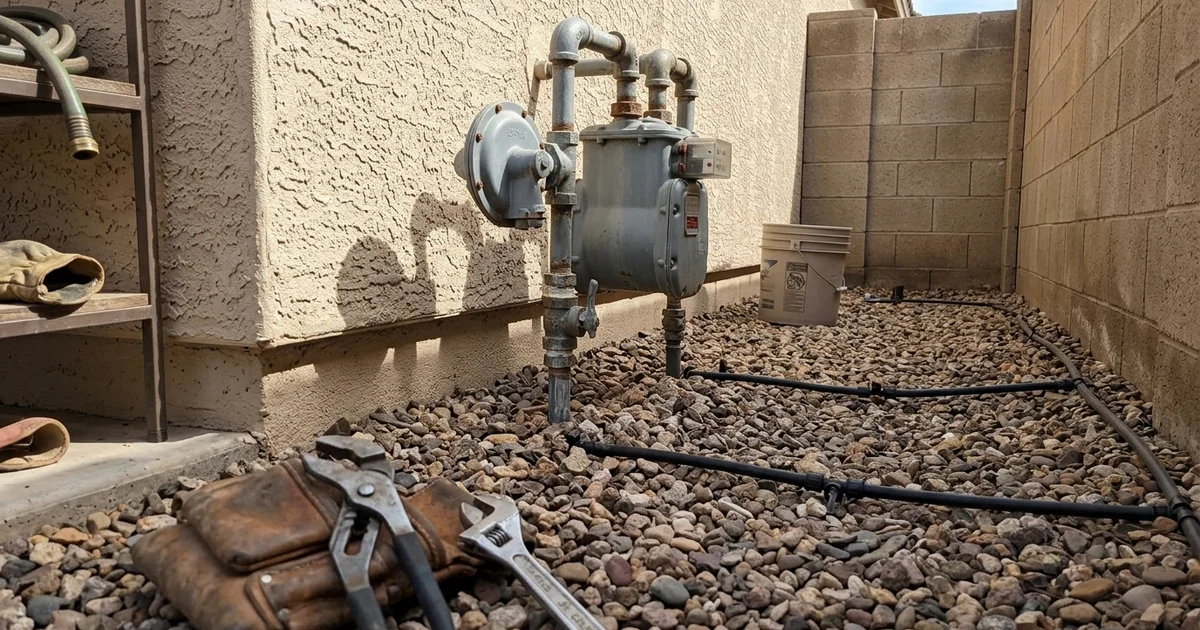
If You Smell Gas Right Now
Stop reading and do this.
- Get everyone outside. People and pets, immediately.
- Do not touch anything electrical. No light switches, no appliances, no garage door opener, no phone while inside. A spark is the one thing the situation is missing.
- Do not light anything. No matches, no lighters, no candles.
- Call from outside, a good distance from the building. Gas utility emergency line first, then us.
The utility can shut off supply at the meter and confirm whether the property is safe to re-enter. That is their job and it is free. Ours is the repair afterward, through gas line services.
The Warning Signs
The smell. Sulphur or rotten eggs. Natural gas is odourless, and this smell is an additive put in deliberately so that leaks are detectable. If you can smell it, treat it as real.
A hissing or whistling sound near a gas line, appliance connection or the meter.
Dead or discoloured vegetation in a line running across a yard, especially a stripe of dead grass where the surrounding lawn is healthy. Gas escaping into soil displaces oxygen at the roots. This is frequently the only sign of a buried outdoor leak.
Dirt or dust blowing up from the ground in a small area with no wind explanation.
An unexplained increase in gas usage on your bill with no change in habits or weather.
Physical symptoms. Headaches, dizziness, nausea, fatigue or eye and throat irritation that improve when you leave the house and return when you come back.
Bubbles in standing water over a buried line after rain or irrigation.
Outdoor leaks often have no smell at all
Gas dispersing into soil does not always reach the surface in a concentration anyone notices. Dead vegetation and a rising bill are the indicators that matter for buried lines.
Utility or Contractor?
| Situation | Call first |
|---|---|
| You smell gas indoors | Gas utility emergency line, from outside |
| Suspected leak on the street side of the meter | Gas utility |
| A carbon monoxide detector has activated | Emergency services, then the utility |
| Confirmed leak on your side of the meter | Us, for the repair |
| New gas line for a range, pool heater or tankless | Us |
| Line damaged during digging | Utility immediately, then us |
The dividing line is the meter. Everything on the street side is the utility’s responsibility. Everything downstream of it, the house piping and appliance connections, is yours and is what we repair.
What Professional Leak Testing Involves
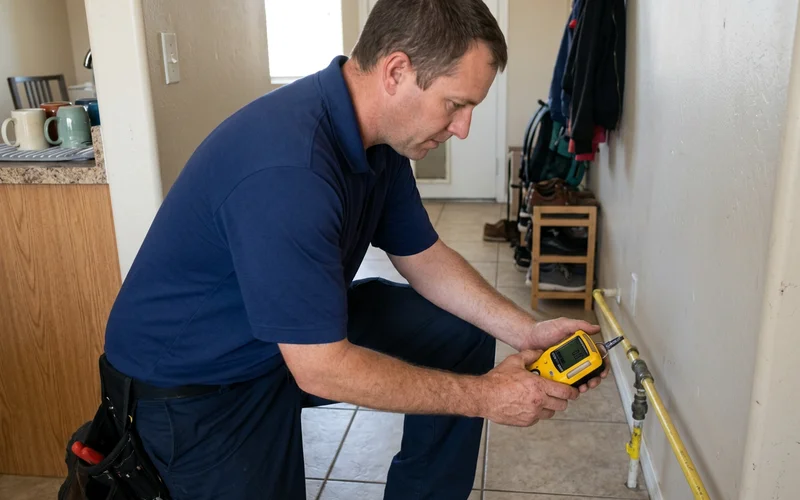
A combustible gas detector is swept along accessible piping, connections and appliance points, and it reads concentrations far below the threshold a human nose detects.
For the piping system as a whole, a pressure test isolates the line, pressurises it with air or nitrogen to a specified value, and holds it. If the pressure drops over the test period, there is a leak, and the drop rate indicates its magnitude. That test also serves as the verification before a repaired system is returned to service.
Buried lines can be traced and located, and soil probes used to detect gas concentration along the route. It is the same principle we apply to the other buried line on the property, where a sewer camera inspection locates the fault before anyone opens the ground.
Repair, Replacement and New Installation
Beyond emergencies, we handle:
- Repair of leaking or corroded gas piping
- Replacement of ageing runs, particularly older black iron showing corrosion
- New installations for ranges, pool heaters, fire pits, outdoor kitchens and tankless conversions
- Gas line sizing against actual BTU demand, which matters enormously on tankless water heater conversions where an existing line frequently cannot deliver what the unit needs
- Pressure testing and leak verification on every job
- Permitting in both states
Gas work is not a category for shortcuts or unlicensed help. If you have a genuine emergency involving water rather than gas, emergency service covers that side, and the same dispatch board runs both.