
Two Regions, Two Different Particles
Our two service areas have air quality problems that look superficially similar and behave completely differently.
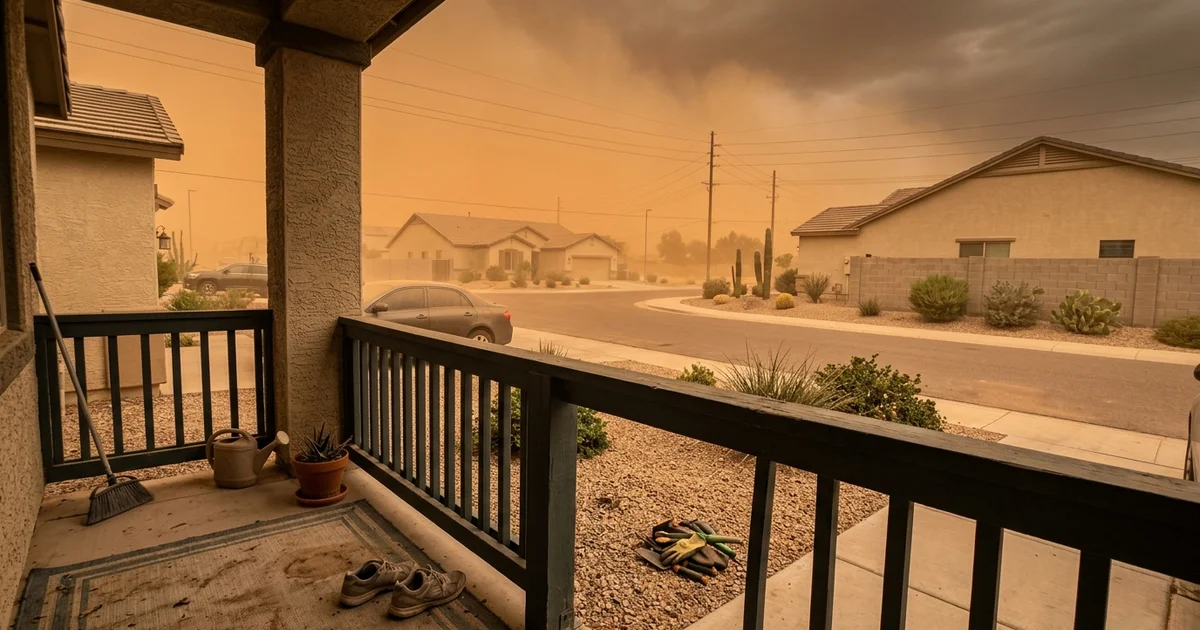
Arizona: volume of coarse particulate. A haboob puts an extraordinary quantity of relatively large dust particles into the air over a few hours. The problem is loading. A filter that was fine yesterday is packed today, and a condenser coil fin pack can foul enough to cost measurable cooling capacity.
California: fine particulate at low concentration. Wildfire smoke carries particles small enough to pass straight through a standard one-inch filter. The problem is capture efficiency at very small sizes, not quantity. A house can smell distinctly of smoke while the system runs continuously.
The equipment that solves one does not automatically solve the other, which is the single most useful thing to understand before spending money. Indoor air quality services covers what each situation actually needs.
What a Haboob Does Within Hours
Fine desert dust is remarkably good at finding its way into a house, and a dust event accelerates every path at once.
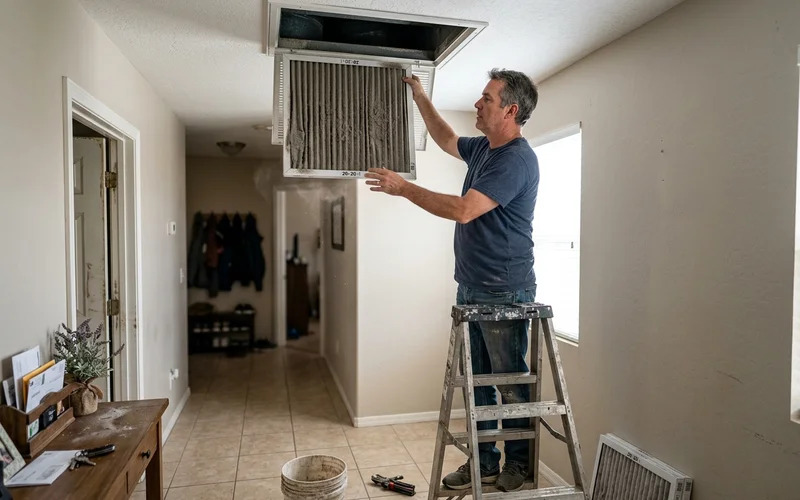
- Filter loading. A one-inch filter can go from serviceable to restrictive in a single event.
- Condenser coil fouling. The outdoor coil pulls a large volume of air through a tight fin pack. Dust packs into it and reduces heat rejection.
- Leaky return infiltration. If your return ductwork leaks in the attic, the storm is being drawn directly into your system past the filter entirely.
- Envelope infiltration. Through gaps, under doors, around windows.
The practical response is to check the filter the following day and to have the condenser coil rinsed after significant events. Both are cheap and both restore capacity immediately.
If a dust storm makes your house dusty, suspect the return
Air that enters through a leaking return duct never passes through your filter. That is a sealing problem, not a filtration problem, and no filter upgrade fixes it.
What Wildfire Smoke Does That Dust Does Not
Smoke particulate is fine enough that ordinary filtration largely ignores it. The result is that a system can run all day during a smoke event and deliver smoky air throughout the house.
There is a second complication specific to smoke season. Smoke events in the LA basin frequently occur in autumn, when cooling demand is falling. A system set to AUTO may barely run, which means the filtration you have is not moving air through itself. That is when continuous fan circulation becomes genuinely useful, provided the filter can capture what you are trying to remove.
Matching Filtration to the Event
| Situation | What actually helps |
|---|---|
| Post-haboob loading | Frequent filter checks, deep media cabinet, coil rinse |
| Ongoing desert dust | Four or five inch media cabinet, longer intervals, sealed return |
| Pollen season | Media cabinet at an appropriate MERV, continuous circulation |
| Wildfire smoke | High-capture media plus active whole-home air cleaning, fan on circulation |
| Odour from a wet coil | UV-C germicidal lamp, which does nothing for particulate |
The structural upgrade that helps most situations is replacing a one-inch filter slot with a four or five inch media cabinet. Far more surface area means high capture at low airflow resistance, and intervals measured in months rather than weeks.
The important caveat is that filtration density must match your blower’s capability. A filter your system cannot pull air through raises static pressure, cuts capacity and shortens blower life. We take a static pressure reading before recommending anything and again after fitting it.
MERV, HEPA and UV-C explained goes through what each technology genuinely does, which is worth reading before buying anything marketed at a season you are currently living through.