
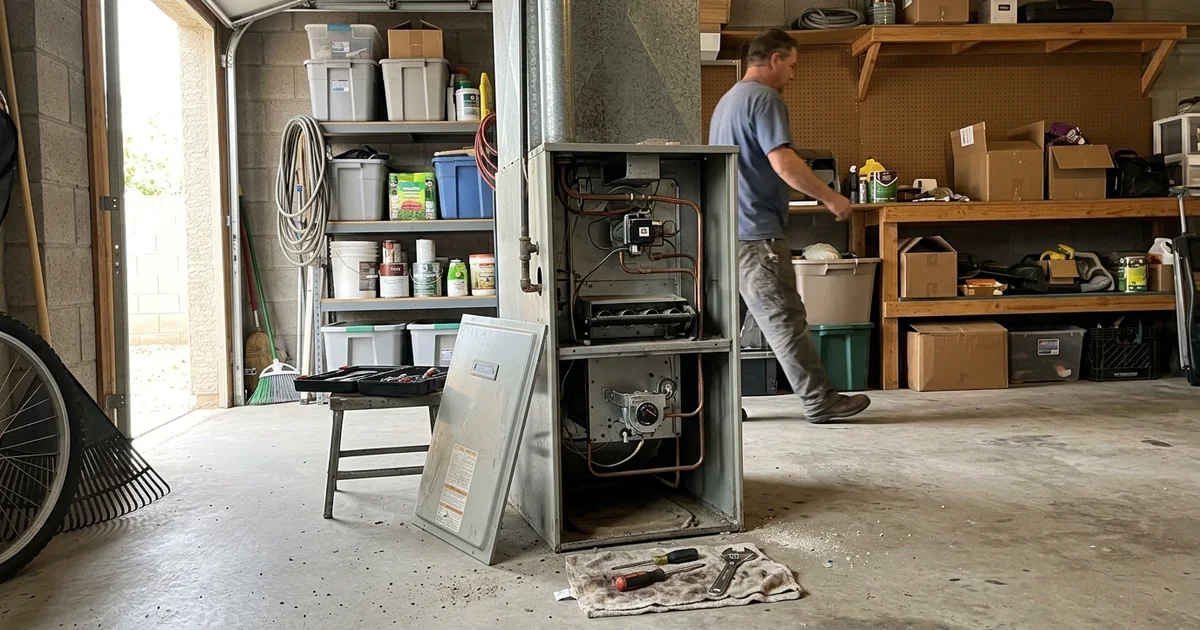
Why the Northern Rule Over-Triggers Here
The standard industry guidance says replace a furnace at around fifteen years. That advice comes from markets where a furnace runs continuously for five or six months a year.
Our furnaces run a handful of weeks. A twenty-year-old unit in Gilbert may genuinely have accumulated fewer heating hours than a ten-year-old unit in Denver, and applying a northern age threshold to it means replacing serviceable equipment.
So the honest framework here weights the specific failure and the combustion condition far more heavily than the number on the data plate.
If your furnace has simply stopped working, start with furnace repair, because most heating faults are ignition components costing a few hundred dollars.
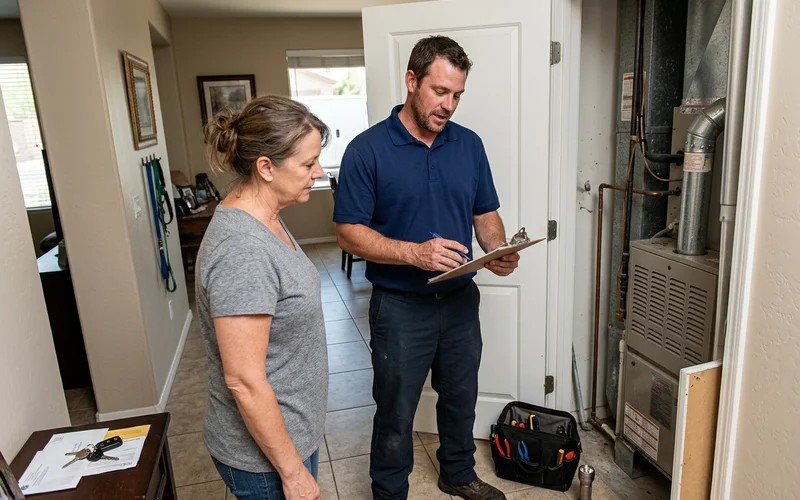
The Four Questions
1. Is it a safety finding? A cracked heat exchanger or an uncorrectable combustion problem ends the discussion. Replace, regardless of age.
2. What component failed? Ignition components, flame sensors, pressure switches and limit switches are cheap repairs on almost any furnace. Inducer motors, gas valves and control boards are more substantial and start to interact with age.
3. How much thermal cycling has it seen? A furnace that has short-cycled for years through restricted airflow has accumulated far more metal fatigue than its hours suggest. This is the input that matters most and the one nobody asks about.
4. Are you replacing the AC anyway? If so, the arithmetic changes substantially, because the shared labor makes the marginal cost of the furnace much lower than doing it separately later.
Short-cycling history matters more than age
Every heating cycle expands and contracts the heat exchanger. The number of cycles fatigues the metal, not the total hours. A frequently short-cycling furnace ages faster than its calendar suggests.
Where the Line Falls
| Situation | Honest answer |
|---|---|
| Any age, cracked heat exchanger | Replace. Not negotiable. |
| Under 15 years, ignition component failed | Repair. Straightforward. |
| Under 15 years, inducer motor or gas valve | Repair, check warranty first. |
| 15-20 years, minor component | Repair, but start planning. |
| 15-20 years, major component | Borderline. Weigh against AC condition. |
| Over 20 years, major component | Leaning replace, particularly if the AC is also ageing. |
| Any age, AC being replaced anyway and furnace is 12+ | Replace both. The shared labor makes it cheaper than doing it later. |
The Paired Replacement Argument
This is the single most useful piece of practical advice on this page.
In a conventional split system, the furnace cabinet contains the indoor blower, and the evaporator coil for your air conditioning sits directly on top of it. They are physically intertwined. Replacing one means opening up the other regardless.
If both are near end of life, doing them together:
- Saves an entire labor visit compared to doing them a few years apart
- Produces an AHRI-certified matched pair, which performs better and matters for rebate eligibility
- Means one commissioning, one permit, one disruption
- Avoids fitting new equipment to an old blower that becomes the constraint
If your furnace is genuinely young and your AC has failed, we will say so and replace only what needs replacing. The paired argument is real, but it is not an argument for replacing serviceable equipment.
Where a Heat Pump Changes Everything
Before committing to a like-for-like gas replacement, it is worth asking whether you should be replacing the furnace at all.
In our California service area particularly, a heat pump handles both heating and cooling from one system, heating hours are moderate enough that it performs well, SCAQMD rules are moving against gas appliances over time, and the state and utility incentive programs lean heavily toward heat pumps over furnaces.
In Arizona the case is more balanced, because gas is cheap and the heating season is short. But it is a genuine question rather than a foregone conclusion, and heat pump alternative walks through the operating cost comparison at regional rates.
If a gas replacement is the right answer, furnace installation and replacement covers why the efficiency tier decision here is different from the rest of the country, and why we frequently recommend the lower tier.