
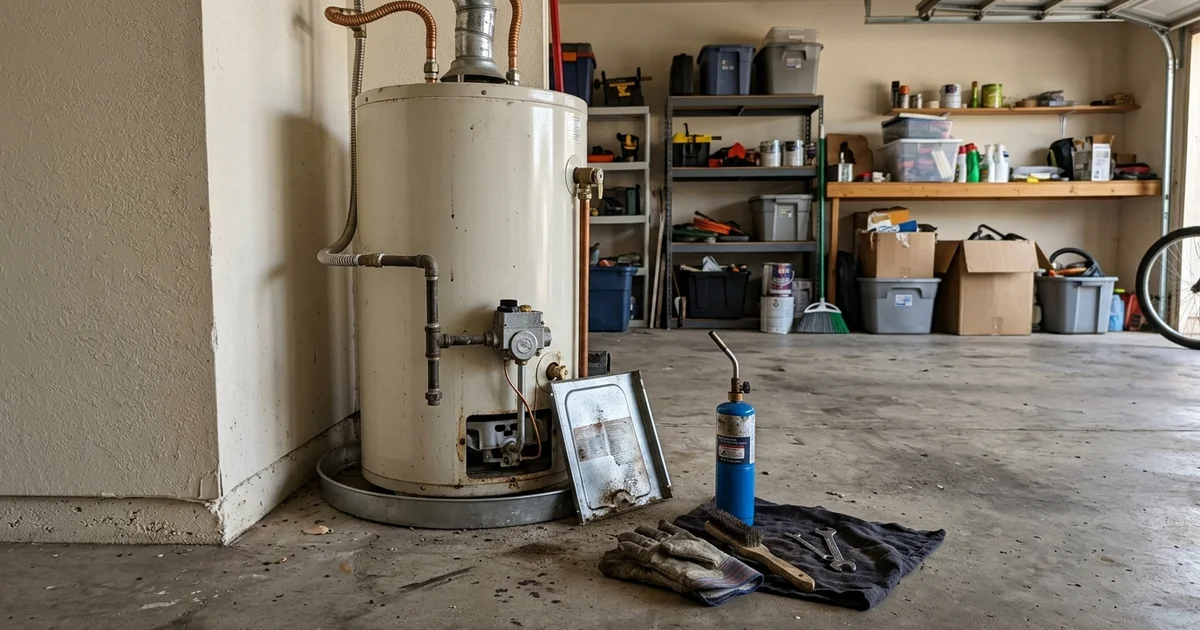
It Is Usually Not the Tank
The most useful thing to know when the hot water stops is that the tank itself is rarely the failed component. Most no-hot-water calls come down to a part costing a fraction of a replacement.
That matters because “your water heater is dead” is an easy thing for a contractor to say and an expensive thing for a homeowner to accept without a diagnosis. Water heater repair starts by finding the actual fault.
Gas Failures
Thermocouple. The most common single fault. A probe sitting in the pilot flame generates a small current that holds the gas valve open. As it degrades the valve reads it as no flame and closes. Symptom: the pilot lights while you hold the button and dies shortly after you release it.
Pilot assembly or orifice fouling. Dust and lint, particularly in a garage installation, block the pilot orifice and produce a weak or unstable flame.
Gas control valve. More expensive, still a genuine repair on a tank with life left.
Tripped ECO high limit. Some units have a thermal cut-off that trips on over-temperature. Resetting it is straightforward. Finding out why it tripped is the actual job.
Venting or draft problems. A blocked flue or a downdraft can extinguish a pilot repeatedly.
Electric Failures
Heating element. Tanks have an upper and a lower element. The lower one fails more often because it sits in the sediment. Symptom: hot water that runs out very quickly, or none at all if the upper has gone.
Thermostat. Drifts out of calibration or fails outright, producing water that is too cool, too hot, or absent.
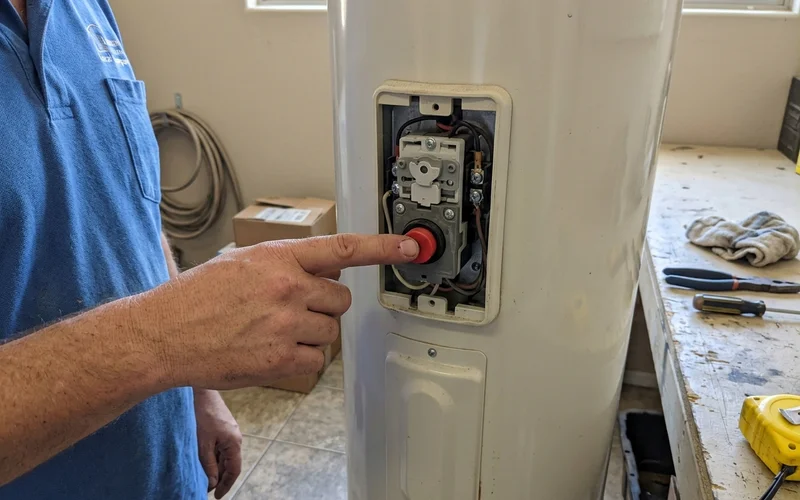
Tripped reset button. A red button on the thermostat panel behind the access cover. It trips for a reason, usually a failing element or thermostat, so a reset that holds for a week and trips again is telling you something.
Breaker. Worth checking first and free to check.
What You Can Safely Check
| Check | Gas | Electric |
|---|---|---|
| Is the pilot lit? | Yes, look through the sight glass | n/a |
| Breaker | Confirm it has not tripped | Confirm it has not tripped |
| Thermostat setting | Verify it has not been knocked | Verify behind the access cover |
| Reset button | n/a | Press once, note if it trips again |
| Gas supply valve | Confirm it is open | n/a |
| Relight the pilot | Only per the manufacturer’s label instructions | n/a |
Do not keep relighting a pilot that will not stay lit
Repeated failure to hold means a component is failing, and the gas valve is doing exactly what it is designed to do. Persisting past that is working around a safety device.
What Lukewarm Water Actually Means
Water that is warm but never hot is a different diagnosis from no hot water at all, and it points at a specific short list.
A broken dip tube. The dip tube directs incoming cold water to the bottom of the tank so it heats before rising. When it breaks, cold water enters near the top where the outlet is, and you draw a blend. Common, inexpensive, and frequently misdiagnosed as a failed tank.
One failed element on an electric unit, producing partial heating.
Thermostat set too low or drifting.
Heavy sediment. A thick sediment layer reduces the effective volume of the tank, so you run out of genuinely hot water much faster than you used to and what remains is tepid. That is a flushing schedule problem and it is entirely preventable.
When It Genuinely Is the Tank
One symptom is not repairable: water weeping or pooling at a seam, a fitting or the base of the tank. At that point the steel has corroded through and no repair holds.
That is also the failure that hard water produces, on a predictable timeline. Hard water damage explains the mechanism, and it is the reason we would rather talk about softening the water than sell you a third tank in a decade.
Everything short of that is worth diagnosing properly first.