
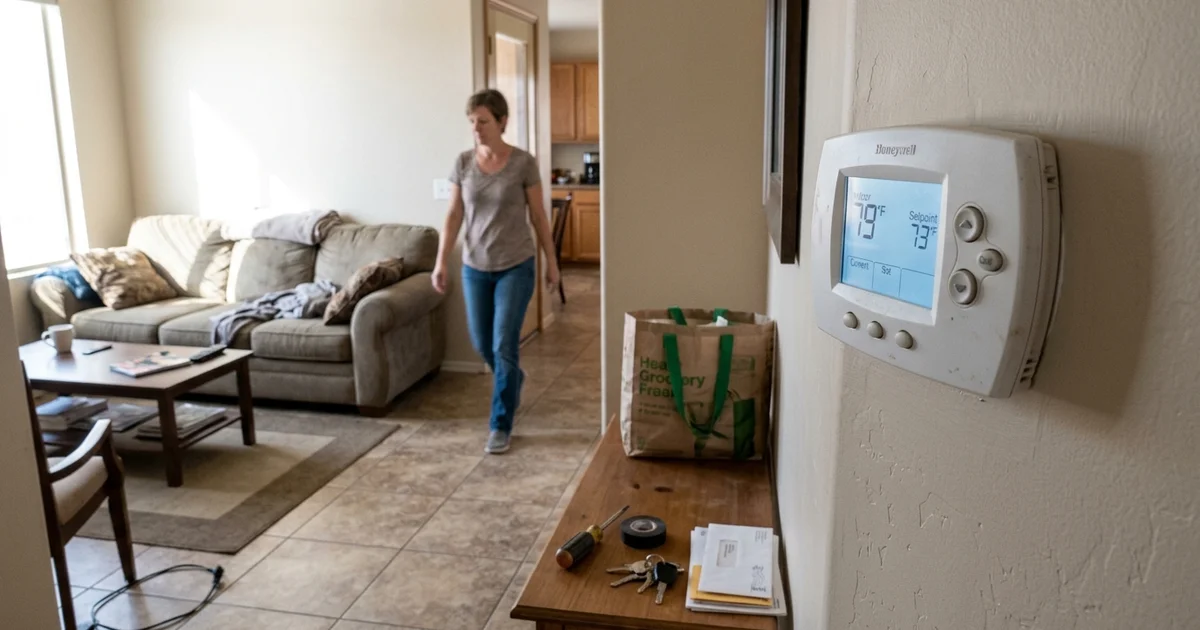
Our team at Comfort Pros AZ and CA knows the panic that sets in when you are dealing with an ac not keeping up in extreme heat on a scorching July afternoon. Extreme heat domes across the US Southwest are pushing residential cooling systems past their limits in 2026.
This intense weather causes massive anxiety for homeowners watching their utility meters spin. We field hundreds of calls during 115-degree heat waves from people convinced their equipment is failing.
It makes perfect sense to worry.
Here is a breakdown of what the data actually tells us and a few practical ways to respond.
The 20-Degree Rule, Explained Properly
Our technicians rely on ASHRAE Standard 180 to evaluate basic cooling performance. This industry benchmark dictates a target 15 to 20 degree differential rule between your return air and supply air. That single design number explains most of what people find confusing about an AC unit in extreme heat.
We measure this temperature drop directly at the indoor unit to see if the system is working correctly. You can expect these typical readings:
- Return Air: 78 degrees entering the system.
- Supply Air: 58 degrees blowing out of the registers.
- The Result: A perfectly functioning 20-degree split.
Our primary concern is the rate of heat gain entering the house through walls, windows, and ceilings. At 115 degrees outside in places like Arizona or California, heat enters fast through any duct running through a 140-degree attic. At some outdoor temperature, the rate of heat gain equals the rate of heat removal, and the indoor temperature stops falling.
We see this equilibrium point sit somewhere in the high 70s for a correctly sized system in a typical Southwest home. That is not a fault. That is the design working at its maximum limit.
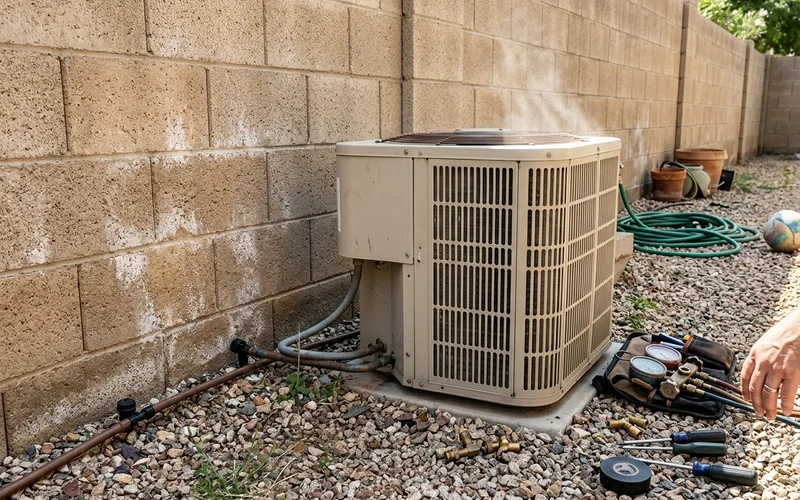
Continuous running is not the same as failing
Our experience shows that most compressor wear actually occurs at start-up due to a massive surge of inrush current. This initial jolt stresses your dual run capacitor and contactor far more than steady operation. A system running continuously for six hours in July is treating its internal components better than a unit cycling on and off every eight minutes. You just need to watch whether the indoor temperature is holding steady or climbing.
Normal Versus Symptom: Is Your AC Not Keeping Up in Extreme Heat?
| Behaviour | Normal in extreme heat | Worth a call |
|---|---|---|
| Runs continuously, holds 78-80 when it is 115 out | Yes | No |
| Runs continuously, indoor temperature climbing | No | Yes |
| Supply air about 20 degrees cooler than return air | Yes | No |
| Supply air only a few degrees cooler | No | Yes |
| Catches up overnight as outdoor temperature drops | Yes | No |
| Never catches up even at 4am | No | Yes |
| Was holding 74 last summer, now struggles at 80 | No | Yes |
Our service team finds that the last row in this table is the most useful diagnostic a homeowner has. Absolute performance is very hard to judge without professional gauges. If your ac cant reach set temperature compared to last season, that performance drop is incredibly easy to spot.
We look for several common culprits when a system loses ground compared to last year. The refrigerant charge might have drifted from a slow leak, or the condenser coil has fouled with dirt. A dual run capacitor could be weakening, or the attic ductwork has developed a severe air leak.
Warning Signs That Shift It From Normal to a Fault
Our dispatchers prioritize calls that show specific mechanical failures rather than just high indoor temperatures. You should reach out immediately if you notice any of these critical red flags.
- Ice visible on the lines or indoor coil: Freezing happens when the evaporator coil drops below 32 degrees. This usually points to a restricted airflow issue or a slow refrigerant leak.
- The supply air split is under 12 degrees: A split of 15 to 20 degrees is healthy. Anything below 12 degrees indicates your system is moving air but failing to extract heat.
- Indoor temperature rises while the system runs: An ac running constantly while the indoor temperature rises means the unit has completely lost the battle against the heat load.
- The system never recovers overnight: A healthy unit will catch up by 4:00 AM when outdoor temperatures drop into the 80s.
- Breaker tripping or fan humming: A humming outdoor fan often means a failed $30 dual run capacitor. Continuing to run the system like this will destroy the much more expensive compressor.
- Frequent top-offs required: With the AIM Act phasing out R-410A refrigerant production in 2026, relying on yearly top-offs for a leaky older system is now incredibly expensive.
We want to emphasize that ignoring these symptoms will turn a small repair into a massive replacement bill. Any of those signs move the situation from a hot day to a mandatory AC repair call. The humming fan in particular is worth reading up on, because the warning signs of a failing capacitor or contactor usually appear days before the unit stops entirely.
What Actually Helps
Our energy auditors find that forcing the thermostat lower does absolutely nothing if the system is already maxed out. You have four proven ways to genuinely improve performance on a 115-degree afternoon. These upgrades tackle the actual heat load.
Reduce the Load Entering the House
We always recommend stopping the heat before it crosses your threshold. Shading on west-facing glass and keeping blinds closed during peak sun hours are free, immediate fixes.
Upgrading your attic insulation to the current US Department of Energy recommendation of R-38 to R-60 for the Southwest is highly effective. The heat that never enters your living space is the cheapest to deal with.
Fix Leaking Ductwork
Our diagnostic tests frequently reveal that uninsulated attic runs dump a massive share of your paid cooling directly into a 140-degree space. Professional Duct sealing and insulation stands as the single largest available improvement in a desert climate.
Technologies like Aeroseal patch leaks from the inside out. This typically saves homeowners up to 30% on cooling waste.
Keep Airflow Completely Clean
We see thousands of systems suffocate simply because of a clogged air filter. Upgrading to a heavy MERV 13 filter might sound great, but it severely restricts airflow during extreme heat.
Downgrading temporarily to a cheaper MERV 8 filter allows the blower motor to push cold air with far less resistance. Keeping the outdoor condenser coil clean is exactly what a seasonal tune-up is meant to handle.
Check the System Sizing Honestly
Our installers know that a unit failing to hold its setpoint since day one was likely undersized at installation. Conversely, an oversized unit will short-cycle and shut off before it ever moves dry air to the back bedrooms.
Figuring out Correct system sizing requires a strict Manual J load calculation, not just a random guess based on square footage. This hard math determines the success of everything else.
Our most important takeaway is that an air conditioner running continuously while holding a stable indoor temperature is simply doing its job. Dealing with an ac not keeping up in extreme heat, where the house temperature climbs relentlessly, means your equipment is asking for help. You should monitor your thermostat over the next 24 hours. Contact a licensed technician today if your system continues losing ground.