
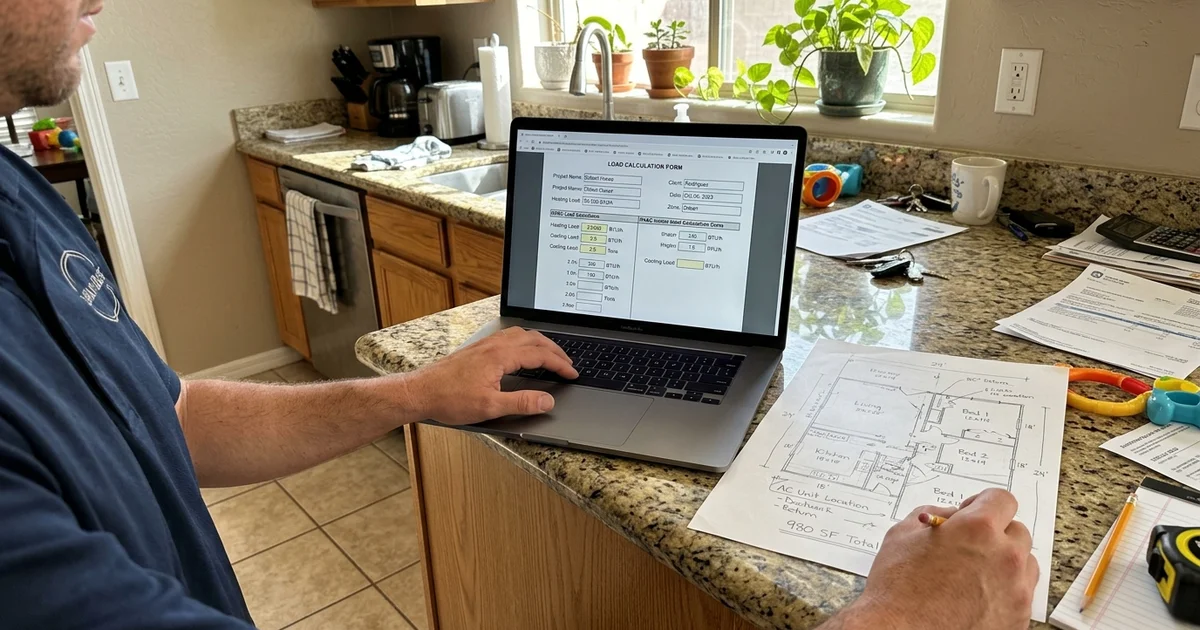
What a Load Calculation Actually Measures
A Manual J load calculation is the ACCA-standard method for determining how much heat a specific house gains on a design day. Not a house of that size. That house.
It accounts for:
- Envelope. Wall and ceiling construction, insulation levels, and the actual assembly rather than an assumption.
- Orientation. A west-facing great room and an east-facing one carry very different afternoon loads.
- Glazing. Window area, glass type, shading coefficient and whether anything shades it. Glass is frequently the largest single component of a Southwest cooling load.
- Infiltration. How much outside air leaks into the house.
- Internal gains. People, appliances, lighting.
- Duct losses. Ductwork running through a 140-degree attic adds load that a whole-house square-footage estimate ignores entirely.
- Design temperature. The actual local outdoor design temperature, which differs meaningfully between Buckeye, Gilbert, Pasadena and Santa Monica.
The output is a number in BTUs per hour, which converts to tons of cooling. That number is the entire basis of a sensible AC installation, and everything else, efficiency tier, brand, features, comes after it.
Why “A Ton Per 500 Square Feet” Fails Here
The rule of thumb exists because it is fast, and it survives because an oversized system rarely generates a complaint the homeowner traces back to sizing.
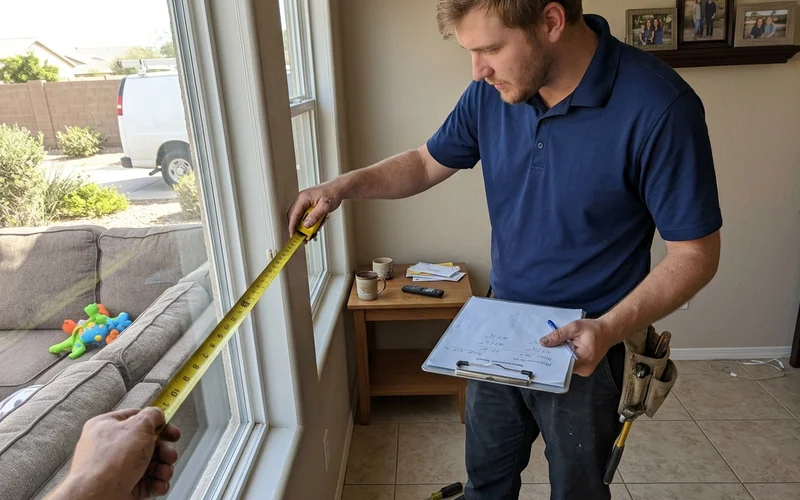
It fails in desert and basin construction for specific reasons. Two houses of identical square footage can have wildly different loads depending on glass area and orientation, and Southwest construction varies enormously between a 1970s Mesa slab home with original single-pane windows and a 2015 Queen Creek build with low-E glass and current insulation standards. Ceiling heights differ. Shading differs. Attic duct exposure differs. And the design temperature in Buckeye is not the design temperature in Santa Monica.
The rule of thumb also has a systematic upward bias. Contractors round up to be safe, because being too small produces an angry customer and being too large produces a quiet one.
The Chandler example
A 1,800 square foot single-storey Chandler home received three in-home estimates, all recommending five tons. The load calculation put the real requirement well under four. That gap is more than a full ton, and it changed the equipment, the price and how the system will behave for fifteen years.
What Oversizing Actually Does
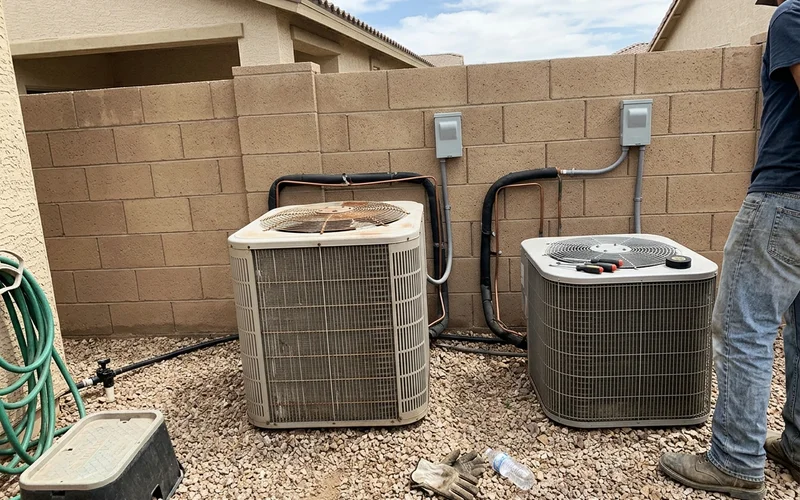
Four consequences, and they compound.
Poor dehumidification. Cooling capacity removes heat. Runtime removes moisture. An oversized system satisfies the thermostat before it has run long enough to pull humidity out of the air, which is why a house can sit at 74 degrees and still feel clammy. This matters more in coastal California than in Phoenix, but it matters everywhere during monsoon.
Accelerated compressor wear. Most mechanical and electrical stress happens during start-up, when inrush current is highest and the compressor is coming up to speed against pressure. Short-cycling multiplies start-ups, and every one of them is a small withdrawal from the compressor’s life.
Uneven temperatures. Air has to physically travel from the air handler to the far bedroom. A system that satisfies the thermostat in eight minutes may never get there, which is why oversized systems frequently produce complaints about one end of the house.
Higher cost, twice. More equipment up front, and worse part-load efficiency in operation. On a variable-speed inverter this is especially wasteful, because inverters are at their most efficient running continuously at low output, and an oversized one spends its life cycling between minimum and off.
Undersizing Is a Real Risk Too
The calculation prevents both errors, and undersizing has its own failure signature.
An undersized system runs continuously and never reaches setpoint on the hottest days, which is not the same as a correctly sized system reaching its design limit. It also runs its compressor at full output for extended periods in high ambient conditions, which is its own kind of wear.
The distinction matters because “my AC runs all the time” is not automatically an undersizing complaint. In extreme heat a correctly sized system runs nearly continuously by design, and that is healthier for it than cycling. The question is whether it is holding temperature.
Reduce the Load Before Buying Capacity
| Step | Effect on the calculation |
|---|---|
| Seal leaking ductwork | Removes duct loss from the load, sometimes substantially |
| Insulate attic duct runs to R-8 | Reduces conductive loss along every foot of run |
| Improve attic insulation | Lowers both ceiling gain and attic duct operating temperature |
| Shade or upgrade west-facing glass | Reduces what is often the single largest load component |
| Nothing at all | You buy capacity to compensate for losses you could have fixed |
This is why we recommend reducing the load first where the duct system is in poor condition. In several homes it has reduced the equipment size the replacement needed, which means the duct work partly paid for itself.
Running It Without a Sales Visit
TrueQuote AI runs a genuine Manual J online from information you provide, then shows correctly sized equipment at several efficiency tiers with real prices attached. Free, no appointment, no follow-up call unless you ask for one.
Once you have the size, choosing an efficiency tier is the next decision, and it is a much easier one when the capacity question is already settled with a number rather than a rule of thumb.