
The Five Causes, in the Order We Actually Find Them
Warm air from the vents is a symptom with a short list of causes, and in this climate the list has a fairly consistent order.
Before any of it, one practical note: if you are reading this with a house that is climbing past 90 degrees inside, same-day AC repair is the faster route than troubleshooting. This page is here so that you know what is happening while you wait, and so that you do not accidentally make it worse.
1. A failed dual run capacitor. The single most common cause we find. The capacitor stores the energy the compressor needs to start, and it is rated for an operating temperature a Sonoran Desert summer routinely exceeds. Symptoms: the outdoor fan hums but does not spin, or the system cools fine in the morning and gives up in the afternoon heat.
2. Low refrigerant from a leak. Air that is cool but never cold enough, gradually worsening over weeks. Refrigerant is not consumed, so if the charge is low there is a leak, and adding refrigerant without finding it is selling the same problem twice.
3. A frozen evaporator coil. Usually caused by restricted airflow from a filter nobody has changed since spring. Presents as good cooling that fades over a few hours and then stops entirely.
4. A pitted contactor. The electrical switch that pulls in the compressor. When its contacts burn, the compressor stops receiving power reliably. Intermittent, then permanent.
5. Breaker or thermostat. A tripped breaker on the outdoor disconnect, or a thermostat knocked to fan-only or heat. Simple, free to check, and worth ruling out first.
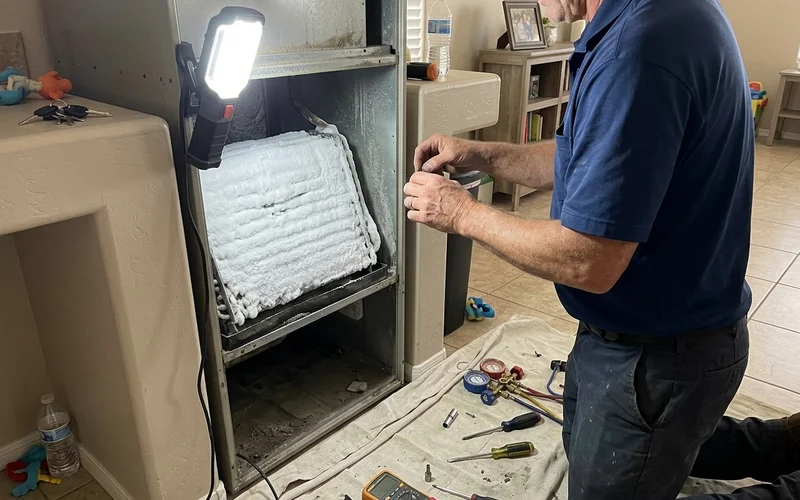
If you can see ice, stop running it
Ice on the refrigerant line or the indoor coil means the system is running with inadequate airflow or low charge. Every additional minute of runtime risks liquid refrigerant reaching the compressor. Turn cooling off, leave the fan on, and let it thaw.
What You Can Safely Check Yourself
Three things, all free, all worth doing before you call:
| Check | How | What it means |
|---|---|---|
| Air filter | Pull it and hold it to the light | If light barely passes, it is restricting airflow and may have frozen the coil |
| Breaker | Check the main panel and the outdoor disconnect | A tripped breaker that resets and holds may have been a one-off; one that trips again is a fault |
| Thermostat | Confirm mode is Cool, setpoint below room temperature, batteries good | Knocked settings are more common than anyone admits |
What you should not do: add refrigerant, open the electrical compartment on the condenser, or pour water on a frozen coil. The first is illegal without certification, the second is dangerous, and the third does nothing useful.
Why This Escalates Faster Above 110
The reason a warm-air call is urgent here rather than inconvenient comes down to two things happening at once.
The house is gaining heat quickly. A typical insulated home gains five to ten degrees an hour through a mid-summer afternoon, so the gap between noticing and needing help is measured in hours, not days.
And the failure mode itself accelerates. A compressor struggling against a weak capacitor draws high amperage and heats up. A system running with a frozen coil pulls liquid refrigerant back toward a compressor designed only for vapor. Both of those are damage accumulating in real time, which is precisely why turning the system off is not giving up, it is limiting the repair.
If the symptoms you are seeing are intermittent rather than total, capacitor failure signs covers the pre-failure window in more detail. And if this is not the first failure this season, repair or replace walks through the thresholds where continuing to repair stops making financial sense.
Most of these faults are a single visit and a part from the truck. The ones that get expensive are the ones where a system was left running through a failure it was already announcing.