Every spring we say the same thing and every July we are proven right again. The parts that strand people in the middle of a heat wave are, almost always, parts that were already measurably out of spec in April.
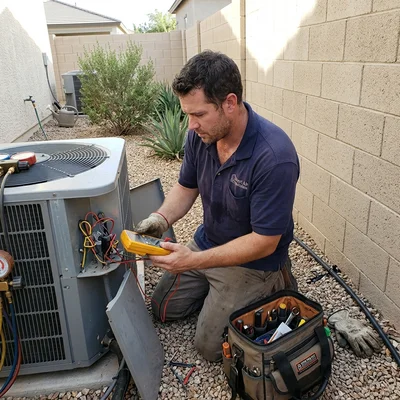
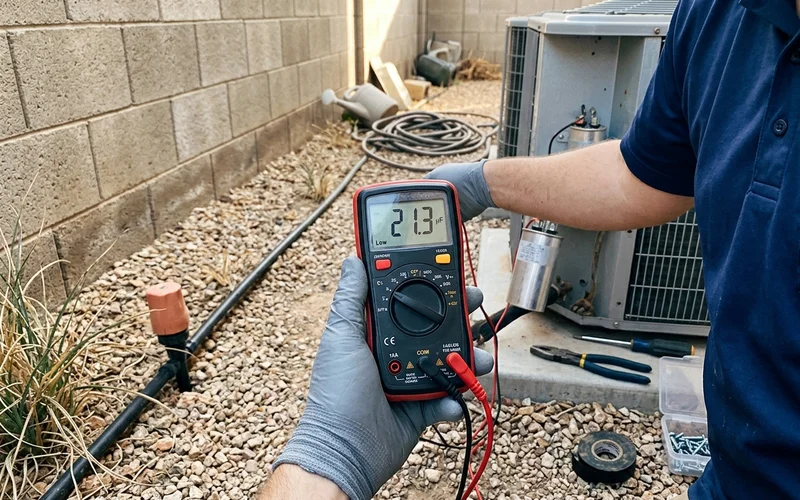
Priya in Scottsdale is the example I use most, because it is exactly typical. She booked a $27 Tru Tune-Up in April. Victor measured her capacitor under load and it read well below its rated value. Fifteen-minute part swap, done, and she never thought about it again.
That capacitor would not have survived July. It would have failed on a Saturday afternoon at 115 degrees with the entire valley’s technician capacity already booked, and it would have become an emergency call in a house climbing five to ten degrees an hour.
Why April Finds What July Cannot Prevent
A dual run capacitor stores the energy the compressor needs to start. It is rated for an operating temperature that a Sonoran Desert summer routinely exceeds, and the dielectric material inside degrades faster the hotter it gets. In milder climates these parts last eight to ten years. Here, three to five is normal, and in Buckeye or Goodyear it can be shorter.
What matters is that the degradation is gradual and measurable long before the failure. A capacitor at seventy percent of its rated value still starts the compressor on a mild April morning. It will not do it on a July afternoon when the compressor is working against high head pressure and the ambient temperature is doing everything it can to make the job harder.
Test under load, not at rest
A capacitor can measure acceptably sitting idle and still fail to deliver start current under real conditions. Testing under load is the only way to catch a part that is degraded but not yet dead. It is the single most valuable measurement in a Southwest tune-up.
What Else the Spring Visit Catches
The capacitor is the headline, but the visit finds other things while it is there.
- Refrigerant charge drift. Subcooling and superheat readings reveal a slow leak long before cooling capacity is obviously down.
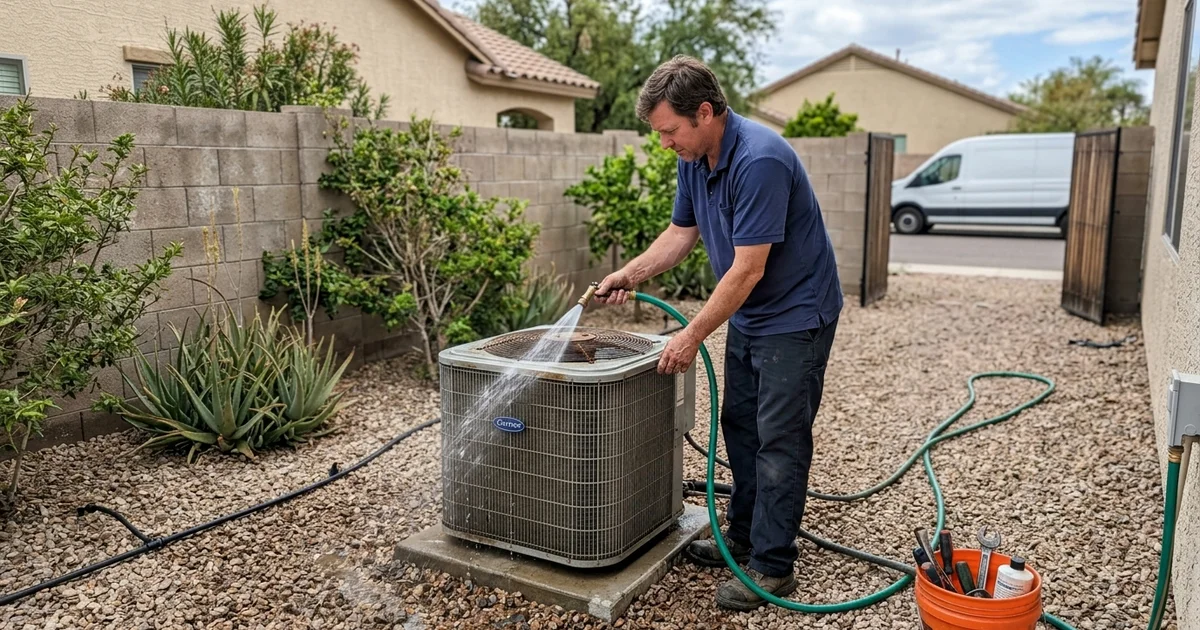
- Condenser coil fouling. After a winter and spring of dust, a loaded coil raises head pressure and costs real capacity. Washing it is cheap and immediate.
- Condensate drain blockage. Clearing it in April prevents the ceiling stain in August.
- Rising amp draw on motors. An early warning on a blower or fan motor heading toward failure.
- Static pressure. If the duct system is restricting the equipment, that is worth knowing before the season it matters in.
The Scheduling Argument
Here is the part that is not about the equipment at all.
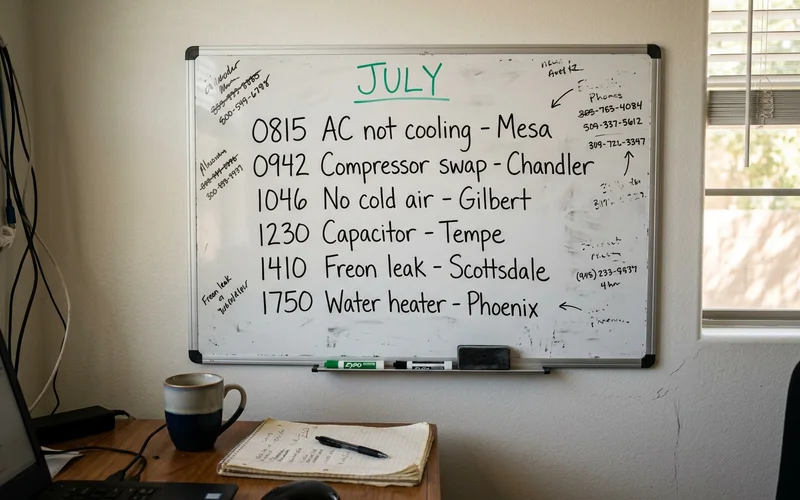
By late June our same-day board fills by mid-morning. From then until September, the schedule is triage: no-cooling calls in occupied homes, prioritised by how bad the situation is. Non-urgent work waits.
The Care N’Comfort membership at $9.99 a month per unit exists partly for this. Members move to the front of the queue during peak season. In the third week of July, that is worth more than any discount we could offer.
| Booked in April | Booked in July |
|---|---|
| $27 per unit, scheduled at your convenience | Emergency diagnostic in a hot house |
| Marginal parts replaced as an errand | Same parts replaced under pressure |
| House stays comfortable throughout | Days of discomfort while you wait for a slot |
| Full hour of measurement per unit | Fast triage focused on restoring cooling |
What About the Warranty
One more thing worth knowing, because most people are never told. Most manufacturer warranties include a clause requiring documented annual maintenance by a qualified technician. Claims on expensive parts do get questioned where there is no service history.
We provide the documentation on every visit as a matter of course. At $27 the paperwork should never be the reason someone skips it.
Book It Now, Not in June
March and April for cooling. October for heating. If you only do one, make it the spring visit.
Get the marginal parts found before the heat does — Book a Tru Tune-Up or call the team in your state.