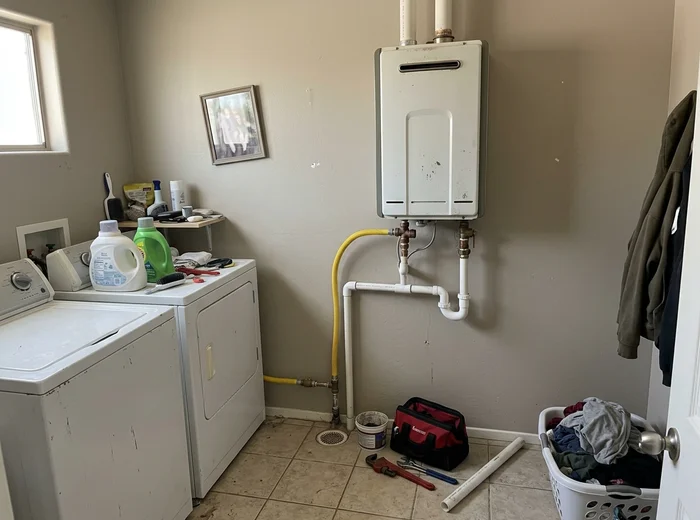
Janet P. had been without reliable hot water for three weeks by the time she called us. The previous company had installed a tankless unit about fourteen months earlier and it had never worked properly. Cold showers, error codes that came and went, a vent termination that turned out to be wrong, and a gas line that could not supply the BTU the unit demanded.
We pulled the unit off the wall, looked at the gas line, the venting and the condensate management, and saw every kind of tankless install mistake in the same place.
What Was Wrong
The gas line was undersized. The unit was a 199,000 BTU condensing tankless. The gas line feeding it was 3/4 inch running about 35 feet from the meter. At that BTU load and that run length, the gas line needed to be 1 inch to deliver the required volume without a pressure drop that would cause the unit to underfire and throw error codes. The original installer had assumed the existing line was adequate, which is the single most common tankless install mistake.
The vent termination was not to code. The concentric vent terminated under a covered patio rather than the required distance from openings, walls, and grade. The unit was drawing combustion air from a space that was not large enough and exhausting into a configuration that put combustion gas back into the patio under certain wind conditions.
There were no service valves. A tankless unit without isolation valves under it cannot be descaled without cutting pipe. The heat exchanger on this unit was already scaled after fourteen months of Maricopa County hard water, which is what made the hot water inconsistent. We could not descale it because there was no way to circulate descaling solution through it without first installing the valves that should have been there from day one.
The condensate line was incorrectly trapped. Condensing tankless units produce acidic condensate that has to drain to a code-approved point. The condensate line on this install had an S-trap configuration that was holding water and occasionally letting sewer gas back into the combustion air path. Another error code trigger.
How We Fixed It
We treated this as a re-install rather than a service call, because at this point the unit was sound but everything around it was wrong. We gave Janet the option of replacing the unit with a different brand, since the existing brand’s track record on this configuration had not been great. She chose to keep the existing unit and have us redo the supporting systems, which was the less expensive path.
Day one. Pulled the unit off the wall. Rerouted the gas line in 1-inch black iron from the meter to the unit location. Pressure-tested the new gas line at 10 PSI for 15 minutes. Removed the old vent and installed a new concentric vent through the wall to the correct termination point with the code-required clearances.
Day two. Installed isolation service valves on the cold and hot connections to the unit. Routed a new condensate line with a code-approved trap to a laundry standpipe. Rehung the unit, connected to the new gas, vent and water. Fired the unit, ran it through the diagnostic cycle, confirmed full BTU output at three fixtures running simultaneously.
Then we descaled it. With the new service valves in place, circulating a mild descaling solution through the heat exchanger took about 90 minutes. The water that came out of the unit on the first flush was the color of strong tea. After two more passes the rinse water ran clear.
The Number
| Line item | What it covered |
|---|---|
| Gas line replacement | 35 ft of 1-inch black iron from meter to unit |
| Gas line pressure test | 10 PSI for 15 minutes, leak check |
| Vent replacement | New concentric vent to code clearance |
| Condensate line | New trap and routing to approved drain |
| Service valves | Isolation valves on cold and hot for descaling |
| Descaling | Two-pass descaling of the heat exchanger |
| Diagnostic and commissioning | Full firing rate and simultaneous-demand test |
Total: $2,650. That is the cost of doing the install right the second time. Doing it right the first time would have been about $400 less, mostly because we would not have spent a day undoing the previous work.
What Janet Got That a Fourth Service Call Would Not Have Given Her
Hot water that works. Three showers running without one of them going cold. A unit that can be descaled on a service call next year rather than requiring pipe cutting. A gas line sized to the unit’s actual demand. A vent that meets code. A condensate line that does not push sewer gas back toward the combustion air intake.
Janet will get a tankless descaling reminder from us annually. That is the maintenance commitment that makes a tankless last, and it is only possible because the install includes the service valves. Without them, the maintenance is a project, and the project gets skipped, and the unit scales up and underfires.
What This Means if You Are Considering Tankless
Three things need to be true for a tankless conversion to work.
The gas line must be sized. Not assumed adequate, not eyeballed, but actually calculated against the unit’s BTU demand and the run length from the meter. If your existing gas line is 3/4 inch and the run is over about 15 feet, you are probably looking at a gas line upgrade.
The vent must terminate to code. That usually means a sidewall vent for a non-condensing unit, or a concentric or PVC vent for a condensing unit, with specific clearances from windows, doors, grade, and property lines. The installer should be able to tell you what code section applies.
The unit must have service valves. Without them, the unit cannot be descaled without cutting pipe. That is the maintenance commitment you are agreeing to when you sign for the install, and it is the difference between a tankless that lasts 18 years and one that scales up and fails at year 6.
If your installer is not talking about all three, the install is being undersold. The number on the quote reflects what is being left out, and you will end up paying for it later.
If you are considering a tankless conversion in the Phoenix area - request a tankless sizing assessment or read more about tankless versus tank water heaters.