Carlos R. had the third pinhole leak on the same hot-water line in eighteen months. The first two had been opened at the slab and patched - both jobs on the same run, both inside the same eight-foot section of copper. When the third pinhole surfaced 22 feet from the first repair, in a different room and a different wall, the question stopped being about patching.
We gave Carlos two options. He chose the right one, and we think it is the choice most Mesa homeowners in his position should make.
The First Two Repairs Set the Pattern
The first pinhole had been in the master bath, six feet from the hall bath wall. The plumber opened the slab, found the failure point, cut back to clean copper on either side, and sweated in a new section. Standard spot repair.
The second pinhole was fourteen months later, eleven feet from the first repair in the same hot line. Different plumber, same approach. Open the slab, find the leak, cut back and patch.
Both repairs were correctly executed. Both held. The problem is that neither of them addressed why the line was failing in the first place.
Why a Third Spot Repair Would Have Failed
The hot-water line under Carlos’s slab was original 1978 soft copper, run in a single continuous length from the manifold to the master bath and the hall bath. Forty-five years of Phoenix hard water at 18 to 22 grains per gallon had internally scaled the line. The pipe wall had thinned unevenly where the scale had built up, creating the conditions for pinhole failures to keep developing in new places.
A third spot repair on the same run would have held for some interval - maybe six months, maybe two years - and then a fourth pinhole would have appeared somewhere else on the same line. We have replaced sections of failed soft copper under Mesa slabs that have been patched four and five times. Each patch is correct. None of them is the right answer once the pattern is established.
What an Overhead Reroute Actually Means
An overhead reroute abandons the under-slab run. The water that used to flow through copper under the concrete now flows through PEX-A through the attic. The hot-water line is rerouted from the water heater up through the attic, across the house to the fixture locations, and down through the walls to the fixtures it serves.
The advantages. PEX-A does not corrode in this water. The new line is accessible for any future service or modification - it runs through the attic, not under concrete. We can add a recirculation line at the same time if the master bath is far from the water heater. The slab never opens again.
The cost. A reroute is more labor than a spot repair because we are running new pipe through the attic and down walls rather than just patching the existing line. The number is higher on a single job, but it is the last number on this scope.
The finish work. The reroute requires opening small sections of wall at the top of each fixture location to drop the new line down to the fixture. Those openings get patched. We do not open the slab at all.
How We Did Carlos’s Reroute
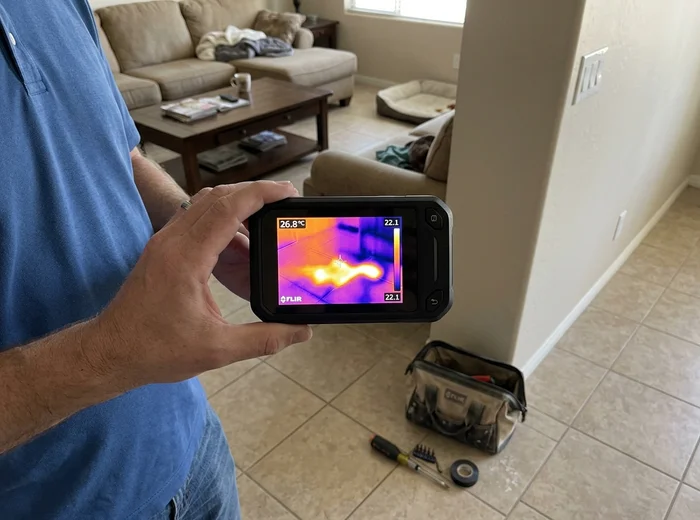
Day one. Walked the attic with a thermal camera and a flashlight. Mapped the truss layout, identified the path of least resistance for the new PEX-A run, and confirmed there were no HVAC duct conflicts or electrical issues that would complicate the routing. We also confirmed the attic had adequate insulation depth to bury the PEX-A in insulation, which is required by code for hot-water lines in attics.
Day two. Cut and capped the old under-slab run at the manifold and at each fixture, abandoning it in place. We do not pull old copper out of the slab - that would mean opening the slab, which defeats the purpose. The abandoned line sits there empty, with no pressure on it, no longer in service.
Day three. Ran new PEX-A from the water heater up through the attic, across to the master bath, dropped down inside the wall to the master bath fixtures. Ran a second line to the hall bath. Both lines buried in insulation sleeves inside the attic. Pressure-tested the new system at 80 PSI for 30 minutes before we closed any access points.
Day four. Reconnected at the fixtures, fired the system, and verified hot-water delivery at both bathrooms. Patched the small wall openings at the top of each fixture location - those patches are square and flat so a finish finisher can match the existing texture.
The Number
| Line item | What it covered |
|---|---|
| Spot repair (the option Carlos did not choose) | Would have been $1,400 to $2,200 with no warranty beyond the patch itself |
| Reroute labor | Attic run, drops, reconnects at three fixtures |
| PEX-A line | About 95 ft of 3/4-inch PEX-A with insulation sleeves |
| Pressure test | 80 PSI for 30 minutes |
| Wall patches | Three access openings at fixture drops |
| Permit | Mesa plumbing permit for the reroute |
| Recirculation line | Added at the same time, ran to master bath |
Total: $3,200 flat-rate, including permit, patches, and the recirculation line that gets hot water to the master bath in under 10 seconds.
What Carlos Got That a Fourth Patch Would Not Have Given Him
A system that will not pinhole in this house again. PEX-A does not corrode in Phoenix hard water. The under-slab line is abandoned, not at risk of another failure. The attic run is accessible - if Carlos ever wants to add a bathroom, run a line to an addition, or modify the routing, the pipe is in the attic, not under concrete.
The recirculation line means Carlos does not run the water for two minutes waiting for hot water in the master bath anymore. That is a quality-of-life improvement that pays back in water savings over the life of the system.
The Honest Decision
If you have one pinhole leak on an otherwise sound line, a spot repair is the right answer. The pipe is sound, the failure was localized, and the patch is durable.
If you have a second pinhole on the same line within a few years, the line is telling you something. A third pinhole is not a question. The line has failed as a system and another patch is treating one symptom.
Reroute costs more on the single job. It is also the last number on this scope. We tell homeowners in Carlos’s position exactly that, and we tell them when the cheaper repair is the right answer instead.
If you have had two or more pinhole leaks in the same line - request a reroute assessment or read more about when a spot repair is the wrong answer.