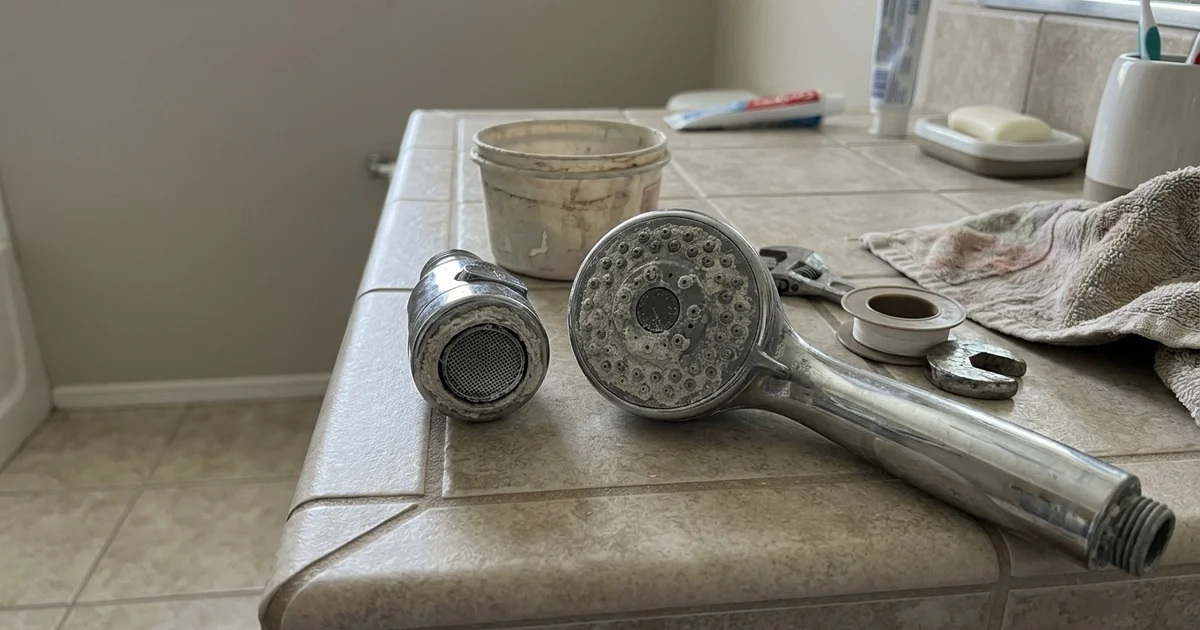
We started tracking hardness test results by neighborhood in early 2025 as part of a quality-control effort on our water heater and plumbing work. By mid-2026 we had readings from 84 homes across the Phoenix metro, taken at the kitchen tap with a calibrated titration kit. This is what we found.
What the Numbers Said
Across the 84 homes we tested, the average hardness reading was 17.8 grains per gallon. The lowest reading was 11 grains, in a home on the far west side where the supply comes off a different treatment plant. The highest reading was 28 grains, in a home in central Mesa where the supply runs through the older SRP canal-fed system.
The distribution looked like this.
| Grains per gallon | Classification | Homes in our sample |
|---|---|---|
| Under 10 | Hard | 3 homes |
| 10 to 15 | Very hard | 14 homes |
| 15 to 20 | Very hard | 41 homes |
| 20 to 25 | Extremely hard | 22 homes |
| Over 25 | Extremely hard | 4 homes |
Every home in our sample was at or above the threshold the EPA uses to classify water as “hard.” The vast majority - 79 percent of homes tested - were above 15 grains, which is the range where the effects on plumbing equipment start to compound.
What the Regional Average Means
The 17.8 grain average is consistent with what the City of Phoenix and the Town of Gilbert publish in their annual water quality reports, which report total hardness in the 15 to 22 grain range depending on the season and the source blend. Our in-home measurements lined up with the published numbers, which gave us confidence that our sample was representative.
What the average does not capture is the household-level variance. A home in Chandler pulling from one treatment plant might see 16 grains. A home two miles away pulling from a different source might see 21. The difference between those readings matters because the equipment inside the house experiences the higher number, not the regional average.
The practical implication is that if you are buying water treatment equipment based on the regional water quality report, you are buying for the average. Your specific house may be 3 to 5 grains above the average. The anode rods in your water heater do not know they were supposed to be in average water.
What the High-End Neighborhoods Mean
The 22 homes in the 20 to 25 grain range and the 4 homes above 25 grains are the ones that see the equipment consequences most directly.
Water heaters. A 50-gallon tank water heater in 22 grain water without treatment is on a 7 to 9 year replacement cycle. The same tank in 15 grain water is on a 10 to 12 year cycle. The 3 grain difference is the difference between replacing a tank once before selling the house and replacing it twice.
Tankless water heaters. Tankless units need annual descaling in this water. In the homes above 22 grains, we recommend descaling every 8 months rather than annually because the scale build-up is faster.
Faucets and fixtures. Faucet cartridges in 20+ grain water last about 18 to 24 months before the seats scale and the cartridges start dripping. In 14 grain water the same cartridges last 3 to 4 years.
Appliances. Dishwashers, washing machines, and ice makers all see accelerated scale accumulation. The lifespan difference on a dishwasher heating element in 20 grain water versus 14 grain water is meaningful.
None of this is theoretical. The data is from the homes where we have done the work and tracked the failure patterns over time.
What This Means for Households That Already Have Treatment
If you are on a salt-based softener, the test should be checking your treated water, not your supply. We test the outlet of the softener on every commissioning. Properly commissioned, the outlet reading should be less than 1 grain per gallon. We have seen a small number of softeners installed by other companies that are bypassing or improperly configured - those homes are paying for salt and getting almost no treatment.
If you are on a salt-free conditioner (template-assisted crystallization or similar), the test will still read high because the system is not removing hardness, it is changing the form of the minerals. The way to verify a salt-free system is working is to look at scale accumulation on fixtures over time. A working salt-free system will visibly reduce scale on faucets and inside the water heater over 12 to 24 months.
What This Means for Households Without Treatment
You are paying the equipment tax. Every water heater, faucet, washing machine, dishwasher, and ice maker in your house is operating in water that is harder than the manufacturer assumed. None of those appliances are designed to last in 18 grain water for their full rated life.
Three options, in order of how much they actually cost over a 20-year horizon.
Do nothing. Pay the equipment tax on every water-using appliance. Replace water heaters every 7 to 9 years instead of every 12 to 15. Replace faucet cartridges twice as often. Replace washing machines and dishwashers a few years early. The cumulative cost is real but spread across enough line items that it does not feel urgent.
Install a salt-based softener. Stop the equipment tax at the source. Every appliance downstream of the softener sees treated water. The cost is a softener ($1,800 to $2,500 installed), salt ($8 to $15 per month), and modest water use for regeneration. The payback is in the avoided water heater replacements and the extended life on every fixture and appliance.
Install a salt-free conditioner. Reduce scale on fixtures and inside the water heater without removing hardness. The cost is lower than a salt softener and there is no salt to maintain, but the protection is partial. Faucets and water heaters see less scale. Soap still does not lather as well as it does in genuinely soft water. Equipment still sees more wear than it would in treated water.
For most Phoenix-area households on 18+ grain supply, a salt softener pays for itself before the first avoided water heater replacement. After that, the softener is doing what the manufacturer always expected the equipment to be doing in - working as designed.
What We Are Doing With This Data
Two operational changes worth noting.
Pre-quote testing. Every plumbing quote that involves a water heater now includes a hardness test at the kitchen tap. We used to quote replacement based on the regional average. We now quote based on what the specific house is getting from the tap.
Treatment conversation on every water heater replacement. When we replace a tank, we have a conversation about hardness, what the equipment will face in this house, and whether treatment is justified. We do not push treatment when the household does not want it. We do make sure the household has the actual number before making the decision.
The point of tracking the data was to make better recommendations for specific households rather than applying a regional rule to every house. The variance is too wide for one rule to be right.
If you want to know what your specific house is getting from the tap - request a hardness test or read more about why hard water kills Arizona water heaters.