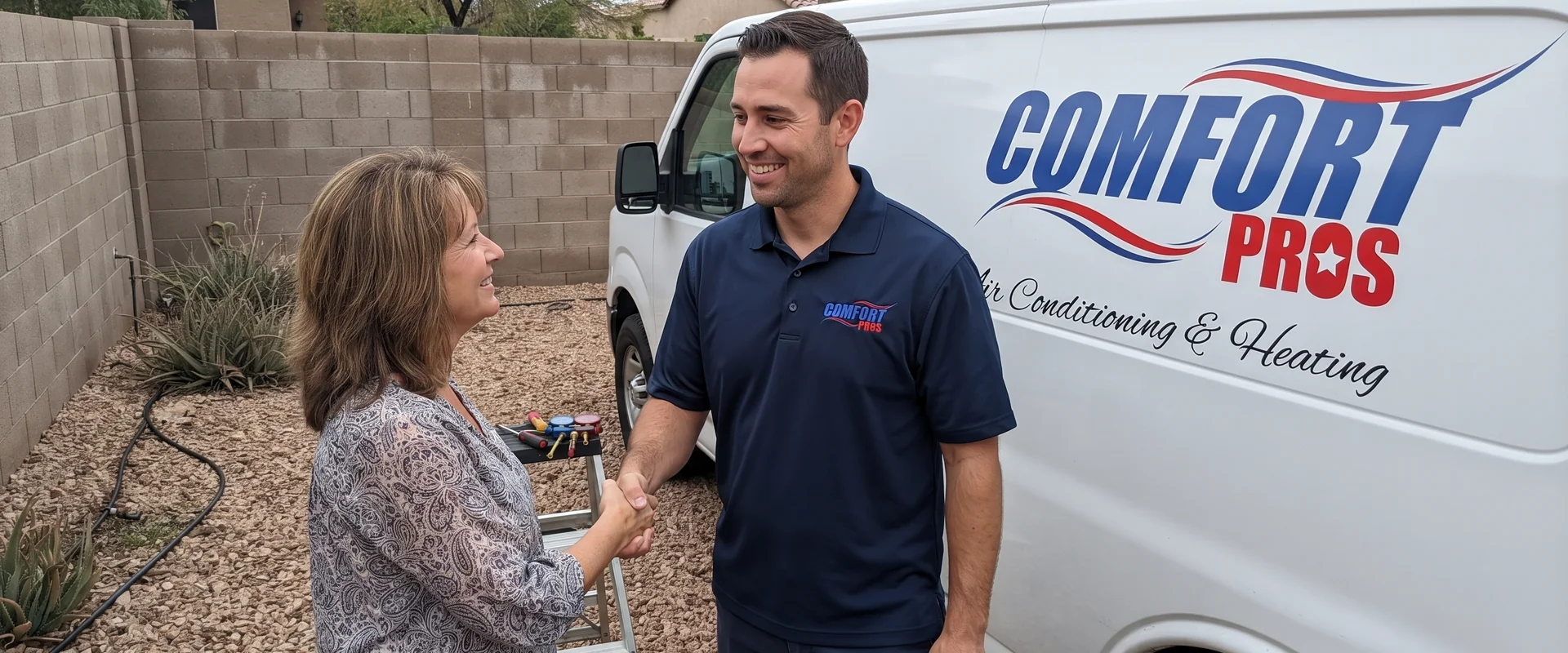
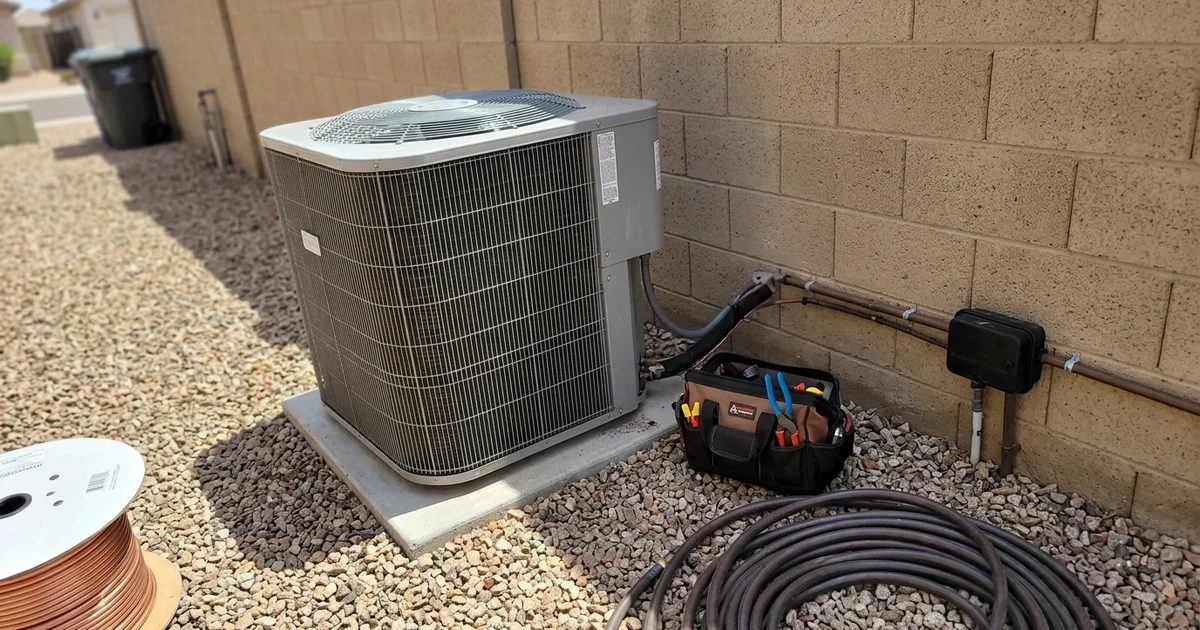
Almost every piece of residential HVAC equipment sold in this country is designed against a national average climate. That average is a useful engineering fiction. It is also a climate that does not exist anywhere we work.
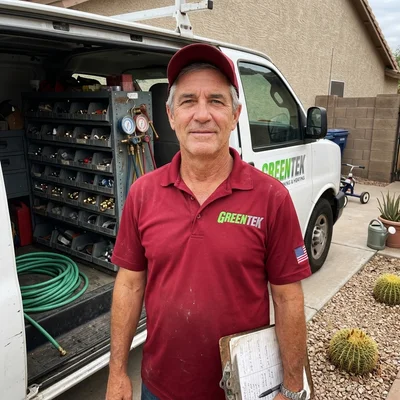
GreenTek is our answer to that. It is our own equipment line, built by Daikin to a specification we set for Arizona and California conditions specifically.
What “Designed for the Average” Actually Costs You
Efficiency ratings are measured under standardised test conditions. Those conditions bear only passing resemblance to a July afternoon in Buckeye, where ambient temperature sits past 110 for hours, head pressure climbs, and a condenser coil is trying to reject heat into air that is already hot.
Three things follow from that, and our technicians see all three constantly:
- Capacitors fail early. Rated for an operating temperature this climate routinely exceeds. Three to five years here against eight to ten elsewhere.
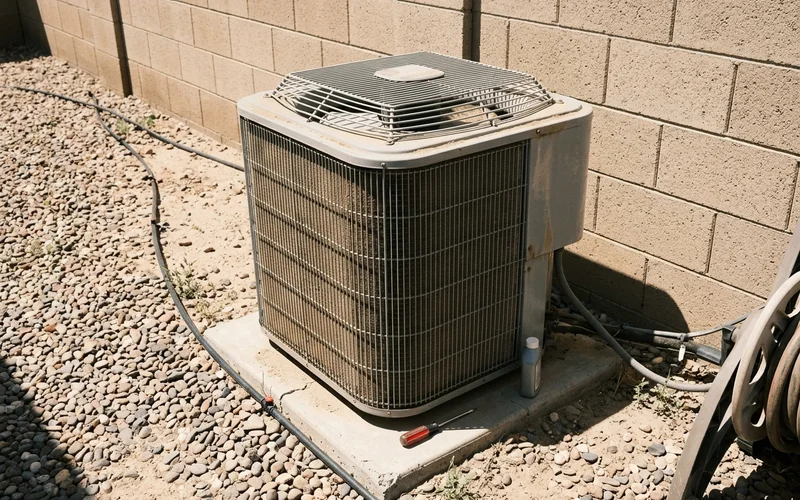
- Coils foul faster. Sonoran Desert dust load, particularly in Queen Creek, San Tan Valley and Gold Canyon, packs fin surfaces at a rate no national maintenance schedule anticipates.
- Capacity derates further than the brochure suggests. Rated capacity is a laboratory number. What matters is delivered capacity at your actual design temperature.
The other half of the problem is coastal
Our California service area has the opposite issue. Santa Monica salt air corrodes standard aluminium fin coils, fasteners and electrical contacts far faster than inland conditions. One equipment specification cannot ignore both extremes.
Why Daikin
We did not want to assemble equipment. We wanted a manufacturer with the engineering depth to build to a specification and the scale to support it with parts and warranty for a decade.
Daikin builds inverter compressor technology at volume and has the range to accommodate a specification rather than only sell a catalogue. That combination is rarer than it sounds.
The practical result is a line specified for sustained high ambient operation, with attention to the components our own service history says fail first here.
What This Does Not Mean
A few things worth being straight about, because house brands have a reputation and some of it is earned.
You are not required to take it. We install Carrier, Lennox, Trane, Ruud and Rheem, and we will quote any of them. If you have a brand preference for warranty, resale or simple familiarity, say so.
It is not automatically the cheapest. It is specified rather than value-engineered, and the price reflects that. TrueQuote AI prices it alongside the alternatives so you can see the comparison rather than take our word for it.
It does not change the sizing conversation. Equipment choice comes after the load calculation, never before. A GreenTek system that is a ton too large is worse than a correctly sized unit of any other brand.
| Typical national-spec equipment | GreenTek by Daikin | |
|---|---|---|
| Design assumption | National average climate | Arizona and California conditions |
| Sustained high-ambient operation | Rated, not optimised | Specified for it |
| Parts and warranty support | Manufacturer network | Daikin network, same depth |
| Availability | Widely stocked | Stocked by us, priced in TrueQuote |
| Required for our installs | n/a | No, one option among several |
Where It Sits in a Quote
When you run TrueQuote AI, the load calculation runs first and produces a required capacity. Equipment options are then priced at that capacity across efficiency tiers, and GreenTek appears alongside the other manufacturers we install.
That order matters more than the brand does. Sizing determines how a system behaves for fifteen years. Brand determines who supplies the parts.
See what a correctly sized system costs across every brand we install — Run TrueQuote AI or read about AC installation and replacement.