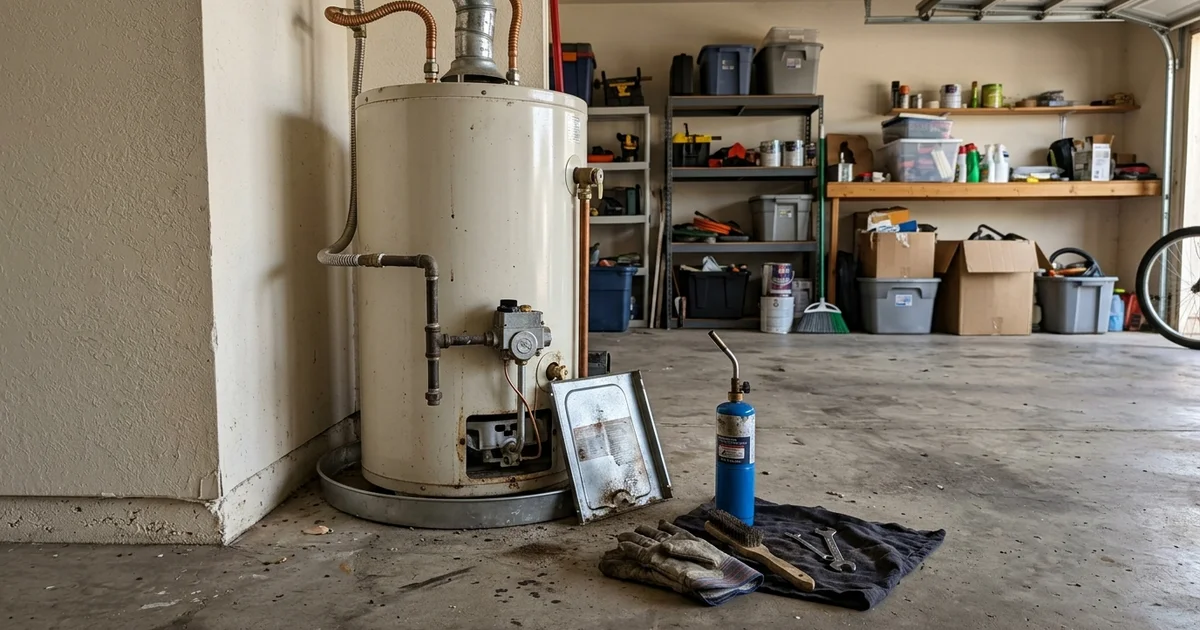
Priya N. had called for the $27 Tru Tune-Up membership sign-up the year before, which is how we already knew her system well. Eight-year-old Bradford White 40-gallon gas water heater, original to the home, installed when the house was built in 2007.
When the tank started leaking from the bottom seam at year eight, we were not surprised. We have replaced tanks that came out of the same Morrison Ranch subdivision under similar circumstances more times than we can count.
What Was Wrong With It
When we drained the tank to pull it, the sediment that came out was not loose. It had cemented into a hard layer that you could not break up with the flush alone - which is what happens when a tank has never been flushed on schedule and the heating element has been baking the calcium carbonate onto the bottom for eight years.
The anode rod was the second find. Bradford White installs a magnesium anode rod from the factory, which is the right call for the chemistry of municipal water in Maricopa County. Magnesium is more reactive than steel, so it sacrifices itself first and protects the tank walls from corrosion. That is exactly what this anode rod had done - it was almost completely gone. About 60 percent of the magnesium had dissolved into the water over eight years, which is on the high end of normal for this water hardness.
The burner tray was caked with white scale. The flame pattern was lazy and yellow instead of sharp and blue. The thermocouple was reading high because the burner was struggling to heat through the scale layer. Every cycle, the tank had to work harder to maintain temperature, and the burner was paying for it.
The leak itself was a tank-bottom seam failure, which is what happens when the steel finally corrodes through after the anode rod has gone. The anode rod is the sacrificial metal. Once it is gone, the next metal to corrode is the tank itself.
The Hard-Water Math
Municipal water in Gilbert runs 15 to 25 grains per gallon. That is “hard” by any standard - the EPA and most plumbing references treat anything above 10.5 gpg as hard. Most Valley homes are running between 15 and 22.
A tank water heater’s anode rod is sized to last roughly the manufacturer’s expected service life of the tank - typically 8 to 12 years in soft water, less in hard water. In Maricopa County municipal supply, the rod is gone in 6 to 8 years. By year eight, the tank itself is unprotected. By year 10, you are on borrowed time.
A water softener cuts that by replacing the calcium and magnesium in the supply with sodium. The water feels different, the fixtures don’t scale up, and the anode rod lasts 12 to 15 years. The tank lasts correspondingly longer. For a family in a Gilbert home they plan to stay in, a softener typically pays for itself in extended equipment life alone.
Priya’s tank failed at year eight. The tank was rated for twelve. The lost four years of service life is the price of not having a softener, and it is not unusual - it is the median outcome for a tank in this water without softening.
What We Replaced It With
Priya went with a Bradford White 50-gallon gas tank for the replacement - one size up from the original. Two reasons: the family had grown since the original install, and the 50-gallon fits the same footprint with a slightly taller height in the same corner. The 50-gallon natural-draft unit we installed is the workhorse tank for East Valley replacements - it costs less than a power-vent or a tankless, has no electronics that the heat can kill, and the parts are common.
We also pulled the old anode rod before install (it was on its last few months), installed a fresh magnesium anode rod, and walked Priya through the flush schedule we want to see on this water heater: every 6 months, not every 12. That is twice the manufacturer recommendation and is the right cadence for 15 to 25 gpg supply.
We did not push a tankless. The case for tankless in this home is real, but it requires either a gas line upgrade or a condensing unit, both of which move the install from “swap a tank” to “rebuild the gas system.” Priya did not want that scope, and the Bradford White tank we installed will give her twelve-plus years if she flushes on the schedule we set. That is a fair outcome for the money spent.
The Numbers
| Line item | What it was |
|---|---|
| Diagnostic | $89, credited to the repair (Priya’s $27 Tru Tune-Up had already paid for itself in earlier visits) |
| Old tank pull and disposal | Haul-away included |
| New Bradford White 50-gal gas tank | Standard efficiency, 6-year manufacturer tank warranty |
| New magnesium anode rod | Sized for 15-25 gpg supply, expected service life 6-8 years |
| New flex water connectors | Code-required on a tank replacement in Maricopa County |
| Expansion tank | Required for closed-loop supply in this part of the county |
| Gas line sediment trap | Code-required drip leg on the gas line |
| Permits and inspection | City of Gilbert plumbing and mechanical permits |
| Total | Flat-rate, on the invoice, no add-ons |
The total was a flat number on a written quote before any work began, and it was the number on the invoice when the work was done.
If You Are in the Same Position
If you have a tank water heater in the East Valley that is more than six years old and you have never had the anode rod checked, that is the cheapest diagnostic on the schedule. A rod swap is a half-hour job and a part that costs less than a service call. If the rod is gone, you have years before the tank starts leaking - that is the window to plan the replacement rather than react to it.
If the tank is already leaking, the math is different. The faster the call, the less water damage to the surrounding area, and the more options you have on replacement because you are not in emergency mode.
If your Gilbert or East Valley water heater is showing its age - request a water heater diagnostic or read more about why hard water kills Arizona water heaters.