
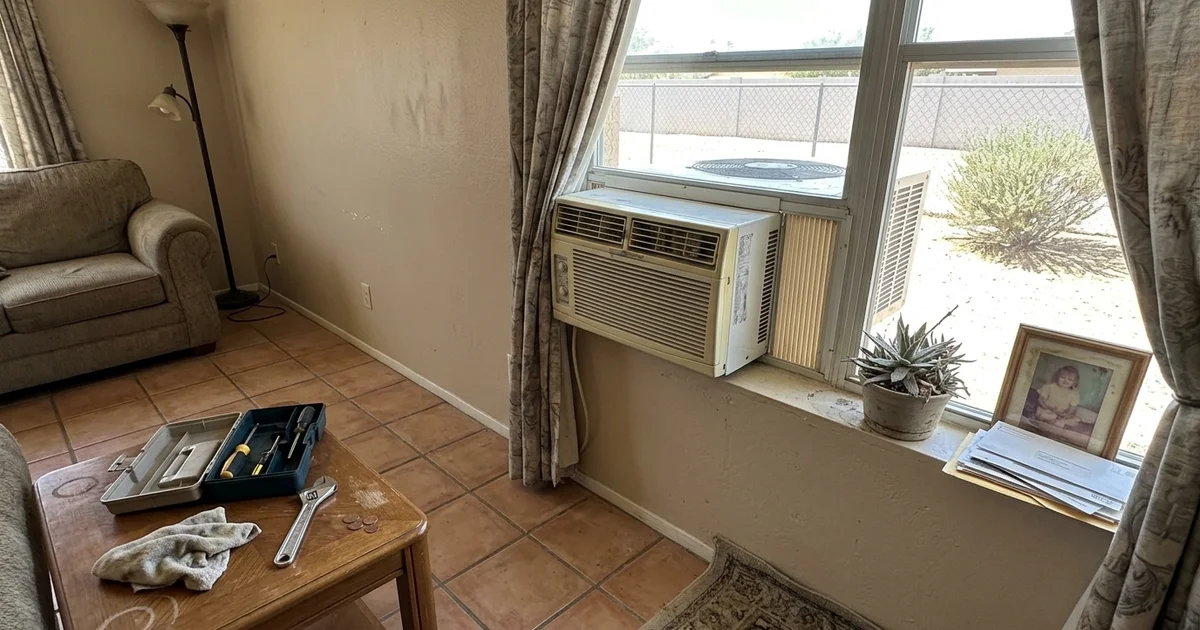
The Three-Way Comparison
Most people arrive at this question with one uncomfortable room and three plausible solutions. Here is how ductless mini splits, central air and window units actually compare in a Southwest climate.
| Window unit | Ductless mini split | Central AC | |
|---|---|---|---|
| Up-front cost | Lowest | Moderate per zone | Highest, includes ductwork |
| Cost per conditioned sq ft | Poor | Good for 1-3 zones | Best for whole homes |
| Performance above 105 degrees | Struggles badly | Holds capacity well | Holds capacity well |
| Efficiency | Lowest | Highest, inverter driven | Good to very good |
| Noise | Loud, inside the room | Very quiet indoors | Quiet, equipment is remote |
| Aesthetics | Blocks a window | Visible indoor head | Invisible, registers only |
| Zone control | Per unit | Per zone with own thermostat | Whole house, or zoned at cost |
| Heating | Rarely | Yes, heat pump | Requires a furnace or heat pump |
| Installation invasiveness | None | 3-inch penetrations | Ducts, chases, significant |
| Lifespan | 5-8 years | 15-20 years | 15-20 years |
Why Window Units Lose Here Specifically
A window unit rejects heat from a small condenser coil into whatever air surrounds it, which on a Phoenix afternoon is 115-degree air with a block wall radiating into it. Its compressor is fixed-speed, so it cannot modulate, and its coil area is a fraction of what a split system has.
Capacity therefore falls off exactly when demand peaks. In practice that means a window unit in a converted garage in Buckeye will run continuously through July and still lose ground.
They are also loud, because the compressor is in the room with you, and they consume more electricity per unit of cooling delivered than either alternative. For occasional use in a mild month they are fine. For a space you use every day in this climate they are false economy.
The lifespan difference compounds the cost gap
A window unit lasting five to eight years replaced twice over the life of one mini split, running less efficiently the whole time, is a considerably more expensive way to cool a room than the up-front price suggests.
When Central Air Wins
If you are conditioning a whole house and you either have sound ductwork or are building new, central air is usually the better economics. Once you pass three or four mini split zones, multi-zone equipment cost per ton climbs and the ductless advantage disappears.
Central air is also invisible. No indoor heads, no line hide channels on exterior walls, nothing to negotiate aesthetically.
The catch is that it depends entirely on the ductwork. A central system on a duct network that fails a static pressure test will underperform regardless of what you spend on the equipment. Central AC installation starts with that measurement for exactly that reason.
When a Mini Split Wins
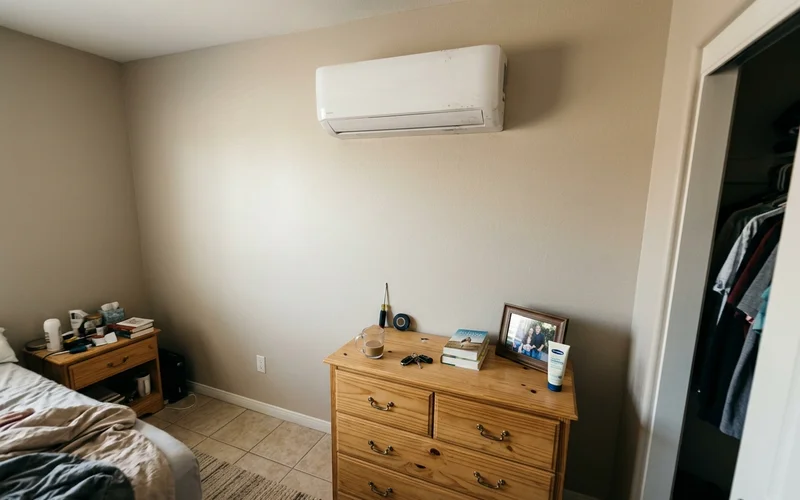
No ductwork exists. Pre-1960 Burbank and Pasadena homes, casitas, detached structures. A conventional duct retrofit into those is a construction project, and mini splits need only a small penetration per head.
One or two spaces need conditioning. Garage conversions, additions, sunrooms. You are solving a local problem and there is no reason to buy a whole-house system.
Per-room control matters. A home office that needs cooling while the rest of the house does not, or a bedroom someone likes colder than everyone else.
The space has an unusual load. Heavy glass, high internal gains, or exposure that the main system was never sized for.
You want heating too. Modern mini splits are heat pumps, which matters in a casita or an addition that has no heat source at all.
Ductless mini splits covers the installation side, and best mini split applications goes through the specific spaces in more detail.
The Option Everyone Forgets
Before adding any equipment, check whether the problem is capacity at all.
A room that has always been warm in a house with central air is frequently a disconnected flex duct run in the attic, an undersized branch, a return path problem, or a system short-cycling because it is oversized. All of those present as “this room does not get cool” and none of them are solved by buying a second system.
A static pressure test and an attic inspection cost far less than any of the three options above, and in a meaningful share of cases they find the actual answer.