
The first call came in at 5:47 in the morning. AC went out overnight in a Scottsdale single-story. Family of five, kids heading back to school in two weeks, house at 91 degrees already and climbing. By 7:15 AM we had four more on the board. By noon, eleven. The day ended with twenty-seven emergency cooling tickets, four no-AC emergencies on the plumbing side, and one slab leak that came in through a back door referral.
This is what a real Phoenix summer day looks like from the dispatch board.
The Pattern Is the Same Every Hot Day
We have been running the same dispatch pattern for fifteen summers. The day before a 115-plus day is busy with tune-up appointments and last-minute capacitor checks. The day of a 115-plus day is dominated by failures that happened overnight or in the early morning when the unit could not keep up. The day after is dominated by units that survived the peak day but failed under the load of a second consecutive extreme day.
Three categories of failure cover about 80 percent of summer emergency cooling calls.
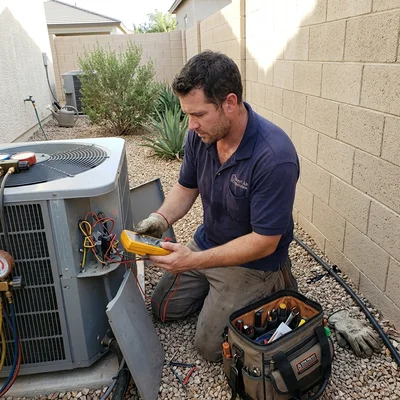
Capacitors. The start capacitor or run capacitor on the condenser fan or compressor fails under heat load. The unit tries to start, the motor cannot overcome the resistance, the overload trips, and the homeowner hears a click instead of the fan spinning up. A $20 part and 30 minutes of labor. We carry common capacitor values on every truck for exactly this reason.
Contactors. The contactor is the relay that sends power to the compressor and fan motor when the thermostat calls for cooling. The contacts weld shut or burn out under repeated cycling in extreme heat. A $35 part and 30 minutes. Same story - common values on the truck.
Refrigerant leaks. A small refrigerant leak that the system tolerated in mild weather becomes a low-charge situation under extreme heat. The system cannot cool to setpoint, runs constantly, and eventually the low-pressure switch trips. Diagnosis takes longer, repair takes longer, and we do not always have the refrigerant on the truck for a same-day repair.
The rest of the failures - blower motors, control boards, reversing valves on heat pumps - are real but they are the minority. Most days in Phoenix summer are capacitors, contactors, and refrigerant.
What No-AC Means at 117 Degrees
Heat illness becomes a real concern quickly. At 117 degrees, the heat index in direct sun can push past 130. Indoor temperatures in a home without AC climb into the 90s within two hours and keep going. Infants, elderly residents, and anyone on a medication that affects thermoregulation are at real risk within a four-hour window.
That is why the dispatch order matters. We prioritize households with infants, elderly residents, or medical conditions that make heat exposure dangerous. We tell homeowners to call a neighbor or family member with AC if they cannot get a same-day visit and the household has anyone in a heat-risk category. Some cities run cooling centers during extreme-heat advisories, and we keep that list updated in the office for homeowners who need somewhere to go today.
For most households, the question is whether to wait for a same-day visit or schedule next-day. We try to get to every no-AC call the same day, but on a 117-degree day we cannot always make that work. Honest about the timing is more useful than promising something we cannot deliver.
What We Tell Homeowners About Pre-Summer Prep
The single biggest predictor of whether a unit survives a Phoenix summer is whether it was serviced in the spring. We see the same data every year. Units that had a spring tune-up fail at about a quarter of the rate of unserviced units. The reason is not complicated - a tune-up catches the components that are about to fail before they fail under peak load.
Coil cleaning. A condenser coil that is half-caked with dust and debris cannot reject heat at its rated rate. The compressor works longer, draws more current, and runs hotter. Under extreme heat load that is the difference between a unit that survives the day and a unit that does not.
Capacitor check. A capacitor that is reading 80 percent of rated microfarad will probably make it through the summer. One that is reading 60 percent is on borrowed time. We replace it during the tune-up rather than during the 117-degree day.
Refrigerant level. A low-charge system that runs in spring weather will run hot under summer load. We measure superheat and subcooling during the tune-up, find any small leaks before they become big ones, and top off if the system is sealed and just slightly undercharged.
Contactors and electrical. Burned or pitted contactor contacts are not a question of whether they will fail, only when. We replace on sight if they are showing wear.
Blower and filter. A restricted blower or a clogged filter makes the evaporator coil ice up under high static pressure, which masks itself as low refrigerant until the system is pulled apart.
The total cost of a spring tune-up is well below the cost of one emergency visit. The math has run itself for fifteen summers.
What We Are Doing Differently This Year
Two changes worth noting.
Pre-loaded capacitors on every truck. Common capacitor values for the most popular equipment in our service area ride on every truck, not in the warehouse. A technician who arrives at a no-AC call and diagnoses a capacitor does not have to drive back to the warehouse for the part. That is a 30-minute repair instead of a 4-hour wait.
Text-message updates. Homeowners on a same-day ticket get a text when the technician is en route, another when the technician is 30 minutes out, and a third when the technician is on site. The number of “where is my technician” calls into the office dropped by half when we started doing this. We are keeping it.
What Phoenix Summers Look Like Going Forward
The pattern is not getting milder. Average summer temperatures in Phoenix have been climbing, and the number of 115-plus days per summer has been increasing. The dispatch board on the worst days of summer is busier than it was ten years ago. We are staffing for it, but the underlying answer is the same as it has been - houses with maintained systems fail less often than houses without.
If you have not had a spring tune-up, schedule one for next spring. If your unit is showing signs of strain now - short cycling, warm air, higher than normal electric bills - the inspection is worth it before we get into the next heat wave. If your unit has already failed, we are answering the phone and getting to you as fast as the dispatch board allows.
If your AC went out today - request emergency cooling service or read more about what to do while you wait for an AC technician.