
Three calls from the same Glendale hillside house in eight months. First call: a running toilet that the homeowner could not stop. Second call: a water heater that started weeping at the T&P valve. Third call: a bathroom faucet that would not shut off fully, no matter how hard the handle turned.
Different fixtures. Different symptoms. Same root cause.
Why a Hillside House Has Different Pressure
Glendale’s hillside neighborhoods - the Verdugo foothills, the Crescenta Valley, the slopes above the 210 - sit at the upper end of DWP’s pressure zones. Elevation change drives incoming pressure higher, and the houses at the top of the hill can see static pressure in the 110 to 140 PSI range coming off the meter.
Residential plumbing is designed for 50 to 80 PSI. Hose bibs, washing machine valves, water heater T&P valves, toilet fill valves, faucet cartridges - every fixture and appliance in the house is rated for that range. When the pressure doubles, every one of those components is operating outside its design envelope.
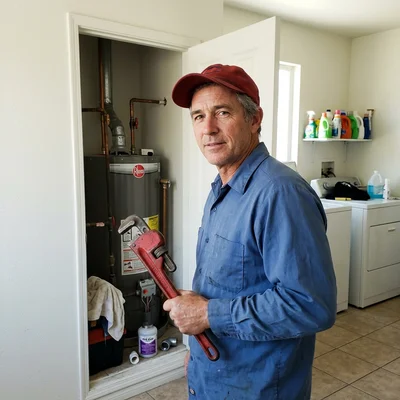
The component that is supposed to protect the house from high incoming pressure is the pressure regulating valve - the PRV. It sits on the main line just after the meter and drops the pressure to a safe level before it enters the house plumbing. When a PRV fails, it usually fails open, meaning the full incoming pressure passes through unreduced.
What the Three Calls Actually Were
The running toilet. A toilet fill valve that will not shut off is one of three things: a bad flapper, a bad fill valve, or pressure that is too high for the fill valve to overcome. The flapper and the fill valve are inside-the-tank fixes. High pressure is a house-wide condition. We replaced the fill valve and it ran again within a week.
The water heater weeping at the T&P. The T&P valve on a water heater is a safety device. It opens when pressure or temperature exceeds a safe threshold, and it is supposed to reseat. When it does not reseat, either the T&P valve itself has failed or the system pressure is exceeding the rating. We replaced the T&P valve and it opened again within a month.
The faucet that would not shut off fully. A single-handle faucet cartridge that will not fully close is almost always a worn cartridge. We replaced the cartridge and the new one developed the same symptom within weeks.
The Moment We Knew
The third call, for the faucet, was the one that prompted the homeowner to ask us to look at the whole house rather than just the fixture. We static-tested the pressure at the hose bib nearest the meter. The gauge read 130 PSI.
That is well into the range where every fixture in the house is operating outside spec. The PRV on the main had failed years ago - probably open, which is the typical failure pattern - and the house had been running at full main pressure since. Every fixture failure in those eight months was downstream of that one cause.
What We Replaced and What We Did Not
We replaced the PRV. New valve sized to the house’s flow demand (about 18 GPM peak for a four-bathroom hillside home), set to 60 PSI static, with a pressure gauge on the downstream side so the homeowner can read the actual house pressure anytime. The PRV install took about 90 minutes including the pressure test.
We did not replace the toilet fill valve again. The new one we had just installed was fine. With the pressure regulated, it would stop running on its own as the system equalized. We checked back in two weeks and the toilet was quiet.
We did not replace the water heater T&P valve again. Same reason. With the PRV back in service the system pressure was below the T&P rating, and the valve reseated properly.
We did not replace the faucet cartridge again. The replacement cartridge was fine. We left it.
We told the homeowner to call us if the running toilet came back, the T&P started weeping again, or the faucet developed the same symptom. None of those calls came. The fixture failures we had treated as isolated were all symptoms of the same problem, and the problem was a $520 part that took 90 minutes to swap.
The PRV Itself
| Line item | What it covered |
|---|---|
| Pressure regulating valve | New 1-inch PRV sized to house demand |
| Pressure gauge | Downstream gauge for ongoing verification |
| Pressure test | Static pressure test at 4 fixture locations |
| Bypass | Bypass valve so the PRV can be isolated for service |
Total: $620 installed. That is roughly the cost of the third faucet cartridge replacement that would have been wasted if we had only fixed the faucet.
What This Means for Other Hillside Houses
If you are on a hillside in Glendale, La Crescenta, Tujunga, Sunland, Eagle Rock or any of the higher elevation neighborhoods in Los Angeles County, your pressure is probably higher than the rest of the city. The PRV on your main is the only thing standing between that high pressure and every fixture in your house.
PRVs are not permanent. They wear, they stick, they fail open. A pressure check at the hose bib takes about 30 seconds and a $15 gauge. If the static pressure reads above 80 PSI, the PRV has either failed or is undersized for the demand. Either way it is a small repair that protects every fixture downstream.
If you are on a hillside and the fixtures in your house keep failing in ways that do not quite make sense - request a pressure test and PRV assessment or read more about the signs of pressure problems in residential plumbing.