A 1979 Calabasas bungalow on a concrete foundation. The homeowner had called a different plumber first, who had run a pressure test, confirmed a leak on the house side of the meter, and quoted a jackhammer-and-search job - “open the floor and find it.” The number on that quote was $6,400 with no warranty on finding the leak in any specific location.
We ran acoustic detection. The leak was located in 70 minutes. One hole. One patch. One invoice.
What the Homeowner Knew Before We Got There
The homeowner had noticed the water bill had gone up. The static pressure test on the house side was running 30 PSI lower than it should have been by morning. The meter test, where every fixture in the house is turned off and the meter is watched to see if it is still spinning, confirmed the leak was on the house side. Beyond that, the homeowner did not know where the leak was.
The first plumber had not located the leak before quoting the repair. That is the part that concerned us. A quote that says “open the floor and search” without specifying a location is a quote for jackhammer time, not for a repair. If the leak turns out to be under the family room and the quote was based on it being under the kitchen, the scope changes mid-job and the number changes with it.
What Acoustic Detection Does
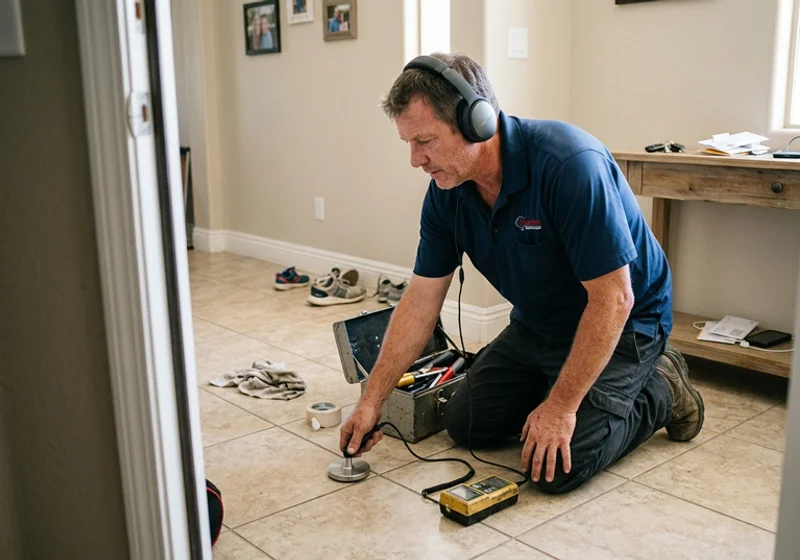
Acoustic detection uses ground microphones and headphones to listen for the hiss of pressurized water escaping from a pipe under pressure. The signal is unmistakable once the technician has heard it - a high-frequency hiss that gets louder as the probe gets closer to the break and softer as it moves away. The leak produces a sound that travels through the concrete and the soil under the slab, and a trained technician can pinpoint the location to within about 12 inches.
The equipment we use is professional-grade - contact microphones that pick up the vibration through the slab surface, ground microphones that listen through the soil, and an amplifier that lets the technician isolate the leak signal from ambient noise (the fridge compressor, the HVAC system, traffic outside). The full setup takes about 10 minutes to deploy.
How We Ran the Detection on This House
The home was a single-story bungalow on a concrete slab with a raised foundation addition at the back. The pressure drop indicated the leak was somewhere on the cold water side (hot water leaks typically show up faster because they heat the slab and show on thermal imaging). We started the acoustic sweep at the front of the house, working from the manifold location toward the fixtures.
The signal was strongest about 18 feet from the manifold, in the family room, near the wall shared with the master bath. The family room floor was a slab-on-grade pour, original 1979, with a wall-mounted air handler in the adjacent attic space. The signal pointed at a spot about two feet from the wall, in the middle of the family room floor.
We marked the location with painter’s tape and verified by listening from three different angles. The signal was consistent and getting louder as the probe approached the marked spot. We were confident in the location to within a 12-inch radius.
What the Opening Revealed
We cut a 24-inch by 24-inch square at the marked location. The concrete was about 4 inches thick, with wire mesh and a moisture barrier underneath. The soil below the slab was damp - the leak had been running long enough that the soil was saturated in a localized area.
The leak itself was in the cold water line that fed the master bath. The pipe was original 1979 copper, and the failure was at a 90-degree elbow where the line turned up from the slab into the wall cavity. The copper at the elbow was visibly green at the failure point - the protective finish had worn through over 45 years, and the leak was a pinhole at the inside curve of the elbow.
We cut back to clean copper on either side of the elbow, sweated in a new section with lead-free solder, and pressure-tested the line at 80 PSI for 15 minutes before closing the slab back up.
The concrete patch went in the same day. The homeowner’s contractor - they had a tile person on standby - replaced the two tiles we had to remove. Total time on site: about 6 hours, including the detection work and the patch.
What the Bill Looked Like
| Line item | What it was |
|---|---|
| Static pressure test | At meter and at fixtures |
| Acoustic leak detection | 70 minutes on site |
| Slab access | One hole, 24-inch by 24-inch |
| Copper repair | New section at elbow, lead-free solder, pressure test |
| Concrete patch | New patch in the opened hole |
| Tile replacement | Two tiles (by homeowner’s contractor) |
| Permit | LA County plumbing permit |
Total: $2,950 flat-rate. The first plumber’s quote had been $6,400 for jackhammer-and-search. The actual cost of doing the work was about half of that, because the detection told us where to open and we opened one hole instead of three.
Why the First Plumber’s Approach Was the Wrong One
Jackhammer-and-search is a real scope for slab leaks. There are cases where acoustic detection cannot pin the location precisely enough, or the host pipe is too degraded to support a spot repair, or the access points are constrained. We have opened slabs the hard way when that is what the job required.
For a 1979 bungalow with original copper that has not been previously opened, the first move is acoustic detection. The leak is almost always locatable. The one-hole approach is faster, less destructive, and cheaper than jackhammer-and-search. The first plumber’s quote was not wrong to include the worst-case scope - it was wrong to lead with the worst-case scope without confirming the location first.
What We Tell Homeowners Who Get a Jackhammer-and-Search Quote
If a plumber tells you they need to open the floor to find a slab leak without first running acoustic detection, ask why. Acoustic detection takes about an hour and locates most slab leaks to within a 12-inch radius. A plumber who skips that step is either not equipped for it, not trained for it, or both.
There are cases where acoustic detection does not work. The leak signal can be masked by background noise on a busy street. The host pipe can be too degraded to produce a clear signal. The slab can be too thick for the signal to travel. Those cases are real, but they are the exception rather than the rule. Confirming the location is a 70-minute visit that costs $350 to $500. The cost of confirmation is well below the cost of opening the wrong section of floor.
If you suspect a slab leak in Calabasas, the San Fernando Valley, or anywhere in LA County - request an acoustic detection visit or read more about the signs of a slab leak.