
The call came in at 7:42 AM. Indoor temperature 91 and the morning was already in flight. The homeowner had a 14-month-old who was awake and uncomfortable and no immediate way to get the house cool. Three previous service companies had been tried, none of them had arrived yet, none of them had given her a time.
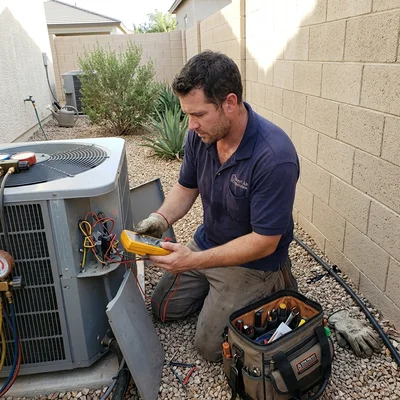
We dispatched at 7:48. Technician on site at 9:12. Diagnosed a failed capacitor in 8 minutes. Replaced it in 22 minutes. House was holding 72 degrees by 9:50. The whole job, drive time included, took less than two hours from the call to a cool house.
Why We Got There Faster
The reason is not that we are better at driving. It is that every service truck in the Phoenix fleet runs a pre-loaded inventory of the components that fail most often in summer. The technician does not have to drive back to a warehouse for the part. The technician does not have to wait until the warehouse opens. The part is on the truck, the truck is on the road, and the diagnosis-to-repair time is the time it takes to replace the part rather than the time it takes to source the part.
Three capacitor values cover roughly 70 percent of the condensers we service in the East Valley. Two contactor values cover another 15 percent. A few common fan motors, a couple of capacitor-relay combinations, and a set of capacitors for the older Rheem and Trane equipment that still shows up in Chandler and Gilbert tract housing from the 1990s.
We do not pre-load refrigerant because refrigerant top-offs without a leak search are a temporary fix. We do pre-load capacitors and contactors because those are the components that fail in a way that is diagnosed and replaced on the same visit.
What Failed on This Unit
The condenser fan motor was trying to come on but could not overcome the resistance. The motor drew current, the overload detected the high amp draw, and the unit shut down. The thermostat called for cooling again, the same thing happened, and the cycle repeated. The homeowner heard the unit clicking on and off outside without ever getting to full operation.
This is the textbook failed capacitor symptom. The meter confirmed it - the run capacitor on the condenser fan was reading 11 percent of rated microfarad. A capacitor that is reading 11 percent is not a capacitor that is about to fail. It is a capacitor that has failed, and the only reason the unit was not completely dead was that the run capacitor was still holding a small charge.
The new capacitor brought the motor up to operating speed within two seconds. The amp draw dropped back to rated. The overload stopped tripping. The unit ran continuously and pulled the house down to setpoint within an hour.
Why This Keeps Happening to the Same Households
We track the failure rates by neighborhood and we see the same pattern every summer. Households that had a spring tune-up fail at about 25 percent the rate of households that did not. Households that had a spring tune-up and the capacitor was within spec fail at a much lower rate than households that did not get a tune-up at all.
The capacitor on this unit had been at 70 percent of rated microfarad in April. We knew that because we had been the company that did the spring tune-up. We told the homeowner the capacitor was on its way out and that it would probably fail before the end of August. She asked whether it could wait until fall. We said yes, with a caveat - if the unit started showing signs of strain, we should replace the capacitor before it failed completely.
She made the call. The capacitor made it to mid-August. The replacement happened the morning she called, on a same-day ticket, with the part on the truck.
What It Cost
| Line item | What it covered |
|---|---|
| Same-day service ticket | Diagnostic fee, dispatch priority |
| Capacitor | $20 part, pre-loaded on truck |
| Labor | 30 minutes of install and testing |
Total: $240 for the visit plus the part. A spring replacement during a tune-up would have been $140 with no diagnostic fee. The difference is the cost of running a no-AC emergency rather than a planned maintenance visit.
What We Tell Homeowners About Same-Day Tickets
Same-day tickets are not a profit center. They are an answer to a problem that did not need to happen. The spring tune-up would have caught the capacitor. The homeowner would have had a planned visit at a time she chose. The part would have been replaced in the same 30 minutes. The total cost would have been less.
The same-day ticket exists because the spring tune-up did not happen, or because the capacitor that was flagged in spring was allowed to run until it failed. We do not judge the call either way. We answer the phone and we show up.
What we do recommend is this: if you had a spring tune-up and the technician told you a component was on its way out, take the recommendation before the component fails. The cost difference between the planned replacement and the emergency replacement is real, and the convenience difference between a scheduled visit and a 91-degree house at 8 AM is real.
What Happened to This Household After
The capacitor we installed is warrantied for one year. The unit itself was 11 years into a domestic rig that had been maintained. We told the homeowner to expect two to four more years on the system, possibly longer if the condenser gets a coil cleaning and a contactor inspection next spring.
She asked whether to put the unit on a tune-up plan. We recommended it. The plan covers the spring visit, the fall check if anything needs attention, and the discount on any same-day ticket that does happen. The plan pays for itself on the first avoided emergency. This household had just paid the difference between the plan rate and the same-day rate, in cash, on a Tuesday morning.
What This Means for Other Phoenix-Area Households
Three things to keep in mind going into the rest of summer.
A unit that is clicking on and off without ever reaching full operation has a capacitor or contactor problem. Those are the components we pre-load. Same-day replacement is realistic when those are the failure mode.
A unit that is running but not cooling may have a refrigerant problem. Refrigerant top-offs without a leak search are a 30-day fix. The right answer is a leak search and a proper repair. We do not pre-load refrigerant for that reason.
A unit that is more than ten years old and has not had a spring tune-up is a same-day ticket waiting to happen. We are answering the phone. We are showing up. The visit you have in April is the visit that prevents the visit you would otherwise have in July.
If your AC went out this morning and you need a same-day visit - request emergency cooling service or read more about what to do while you wait for an AC technician.